
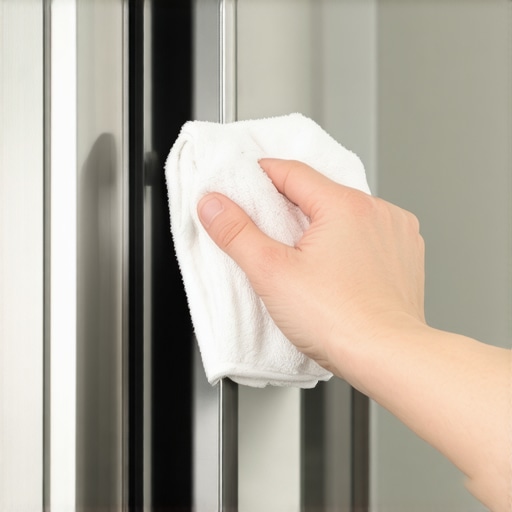
I stood in my kitchen last Tuesday, coffee in hand, and realized I couldn’t actually see my reflection in my refrigerator. Instead, I saw a roadmap of every snack-run fingerprint, a few mysterious oily smudges, and those dreaded gray cloudy marks from my last failed attempt at cleaning. It felt like my kitchen was wearing a dirty coat. I used to think that a heavy-duty spray and a rough paper towel were the answers, but I quickly learned that [choosing the right refrigerator](https://smartappliancereview.com/choosing-the-right-refrigerator-tips-from-industry-experts) is only the first step; keeping it from looking like a finger-painted mess is a whole different skill set. If you have ever felt defeated by a piece of sheet metal that refuses to shine, I am here to tell you that it is not your fault. You probably just haven’t been taught the ‘grain’ secret yet. Today, I am sharing the exact routine that turned my streaky nightmare into a mirror-like finish that actually lasts more than ten minutes.
Stop Fighting the Metal and Start Following the Grain
When I first moved into my place, I treated my fridge like a chalkboard. I’d scrub in big, ambitious circles, thinking that elbow grease was the cure for everything. I was so wrong. I ended up with microscopic scratches and a hazy residue that seemed to attract more dust than before. It turns out that [refrigerators in 2025](https://smartappliancereview.com/refrigerators-in-2025-top-features-that-transform-your-kitchen) still require a bit of old-school finesse. The surface of stainless steel has a directional grain—much like wood—and if you aren’t wiping in line with those tiny grooves, you are basically trapping grime inside them. According to the [Specialty Steel Industry of North America](https://www.ssina.com/education/cleaning-stainless-steel/), the ‘passive layer’ of chromium oxide that makes the steel stainless can be compromised if you use harsh abrasives or scrub against the natural flow of the metal. I learned the hard way that less is almost always more when it comes to chemical cleaners. Have you ever spent an hour cleaning your kitchen only to have a single smudge ruin the whole look? I’d love to hear your biggest fridge-cleaning pet peeve in the comments!
Is that fingerprint-resistant coating actually worth the hype?
While many modern [top smart appliances for a seamless home experience](https://smartappliancereview.com/top-smart-appliances-for-a-seamless-home-experience-in-2025) promise to repel every smudge, the truth is that even ‘resistant’ surfaces need a gentle touch to maintain their luster. I used to ignore the care instructions because I thought they were just being over-cautious, but after dulling the finish on my last unit, I realized those guidelines are there for a reason. Whether you are dealing with a standard model or you’ve finally figured out [how to fix a loose handle on your stainless steel refrigerator](https://smartappliancereview.com/how-to-fix-a-loose-handle-on-your-stainless-steel-refrigerator), the cleaning method remains the same: respect the metal, and it will respect your reflection.
Gather Your Supplies Without Breaking the Bank
I have spent far too much money on ‘specialty’ sprays that claim to be the only solution for stainless steel. The truth is much simpler. Most of the time, you already have the best cleaners in your kitchen. Just as you might look for [innovative dishwashers with AI technology](https://smartappliancereview.com/innovative-dishwashers-with-ai-technology-you-must-know) to simplify your chores, a simple mix of mild dish soap and warm water is the most effective way to degrease a fridge door. Use two microfiber cloths: one for the soapy water and one that stays completely dry. This prevents the soap from drying into those white, hazy spots that drive us all crazy.
The Magic of Simple Dish Soap and Warm Water
Start by dipping your cloth into the soapy water and wring it out until it is barely damp. You don’t want water dripping into the vents or the dispenser. If you are dealing with a newer appliance, you might be struggling with [how to remove that sticky residue left behind by new appliance stickers](https://smartappliancereview.com/how-to-remove-that-sticky-residue-left-behind-by-new-appliance-stickers). A tiny bit of rubbing alcohol on a cotton ball will dissolve the adhesive without scratching the finish. Once the residue is gone, go over the area with your soapy cloth to neutralize the surface.
Identifying the Direction of Your Metal Grain
This is the part that changed my life. Look very closely at your fridge. You will see tiny, faint lines running either horizontally or vertically. That is your grain. Wiping against it is like trying to comb your hair the wrong way—it creates friction and traps dirt. Always move your cloth in long, steady strokes that follow those lines. This method isn’t exclusive to standard steel; it’s also the core of [the best way to clean the outside of a black stainless steel fridge](https://smartappliancereview.com/the-best-way-to-clean-the-outside-of-a-black-stainless-steel-fridge). If you’ve noticed any permanent discolorations while doing this, you might need to look into [how to get rid of a permanent stain inside your fridge](https://smartappliancereview.com/how-to-get-rid-of-a-permanent-stain-inside-your-fridge) for the interior surfaces.
Apply the Secret Finishing Touch for Long-Lasting Luster
Once your fridge is clean and bone-dry, it probably looks better, but it might lack that deep, showroom glow. This is where the ‘oil trick’ comes in. Think of this step like polishing a piece of fine wood furniture. You are creating a very thin, protective barrier that makes future fingerprints easier to wipe away with just a dry cloth.
#IMAGE_PLACE_HOLDER_B#
Don’t Overdo the Oil or You’ll Create a Dust Magnet
I learned this lesson the hard way about three years ago. I thought that if a little oil was good, a lot would be better. I buffed about two tablespoons of olive oil onto my fridge door until it shone like a mirror. It looked amazing for exactly twenty minutes. Then, my golden retriever walked by, and her fur stuck to the fridge like it was magnetic. I ended up with a hairy, greasy mess that took an hour to scrub off. Now, I use exactly two drops of mineral oil or lemon oil on a clean microfiber cloth. Buff it in the direction of the grain until the surface feels smooth, not slippery. While you are focusing on the exterior, remember that a truly clean kitchen involves the parts you can’t see, like knowing [how to keep your refrigerator coils clean in a pet-friendly home](https://smartappliancereview.com/how-to-keep-your-refrigerator-coils-clean-in-a-pet-friendly-home) to prevent efficiency drops.
Stop Rinsing Your Plates Before Loading the Dishwasher
I used to be a chronic ‘pre-rinser.’ I would scrub every plate until it was basically clean before loading it into the rack, thinking I was doing my machine a favor. It turns out I was actually sabotaging the wash cycle. Most modern [innovative dishwashers with AI technology](https://smartappliancereview.com/innovative-dishwashers-with-ai-technology-you-must-know) are equipped with sophisticated turbidity sensors. These sensors detect how much ‘gunk’ is in the water to determine the cycle’s length and intensity. If your dishes are already clean, the machine concludes its work is done and switches to a lighter cycle, which can lead to [why your dishwasher is leaving a cloudy film on glasses](https://smartappliancereview.com/why-your-dishwasher-is-leaving-a-cloudy-film-on-glasses) because the detergent didn’t have enough organic material to react with. According to the Association of Home Appliance Manufacturers (AHAM), pre-rinsing can waste more than 6,000 gallons of water per year without improving cleanliness. Have you ever fallen into this trap of ‘cleaning before you clean’? Let me know in the comments!
Why Your Modern Washing Machine Actually Hates Suds
There is a massive misconception that more bubbles equal more cleanliness. In the world of high-efficiency (HE) laundry, this couldn’t be further from the truth. In fact, [why your washer doesn’t need a whole cup of detergent to get clothes clean](https://smartappliancereview.com/why-your-washer-doesnt-need-a-whole-cup-of-detergent-to-get-clothes-clean) is rooted in the way modern drums move. Excessive suds create a ‘cushion’ between the clothes, preventing the fabric from rubbing together—which is exactly how the dirt gets agitated out. Even worse, those extra suds settle in the outer tub and become a breeding ground for mold, leading to [the only way to get that weird smell out of your front loader](https://smartappliancereview.com/the-only-way-to-get-that-weird-smell-out-of-your-front-loader). I always recommend using only two tablespoons of HE detergent at most, regardless of what the cap size suggests.
#IMAGE_PLACE_HOLDER_C#
Are You Accidentally Shortening Your Appliance’s Lifespan?
Let’s talk about the ‘Oops’ factor that costs homeowners thousands in repairs: the overuse of vinegar. I know, every ‘green’ cleaning blog suggests vinegar for everything, but it is a mild acid that can be incredibly destructive to the internal rubber components of your expensive gear. If you use it too frequently to ‘freshen’ things up, you might find yourself searching for [how to deep clean the gasket on your dishwasher to prevent leaks](https://smartappliancereview.com/how-to-deep-clean-the-gasket-on-your-dishwasher-to-prevent-leaks) much sooner than expected because the rubber has become brittle and cracked. When you are looking for [top smart appliances for a seamless home experience](https://smartappliancereview.com/top-smart-appliances-for-a-seamless-home-experience-in-2025), keep in mind that their precision engineering requires specific care. Respect the seals and the sensors, and they will keep your utility bills low and your kitchen running smoothly for a decade or more.
Your Fridge Has a Secret Trap Door and You Need to Find It
Beyond the streaks and the suds, there is a whole world of mechanical maintenance that most homeowners ignore until a repairman charges them $300 to press a button or clear a clog. I recently discovered that most modern units have a ‘hiding spot’ for debris. If you haven’t checked, you might find that the secret drain filter at the bottom of your fridge you never knew existed is actually the culprit behind that faint musty smell in your kitchen. I personally keep a simple, narrow-nozzle shop vac and a long-handled condenser brush in my utility closet specifically for this. It takes five minutes once a quarter, but it saves your compressor from working double-time. According to the Association of Home Appliance Manufacturers (AHAM) technical bulletin on service life, a mere 0.1 inches of dust on your coils can increase energy consumption by 30% and significantly shorten the motor’s lifespan.
Software Updates Are the New Oil Change
We often think of appliances as purely mechanical, but in the era of future of home appliances-trends to watch in 2025, your dishwasher is basically a computer that happens to spray water. I’ve found that many of the ‘glitches’ people complain about—like a cycle ending early or a sensor misfiring—can be solved by simply checking for a firmware update. I recommend that you how to sync your smart kitchen appliances to one app so you can receive push notifications when a patch is available. It feels strange to ‘update’ a washing machine, but these patches often optimize water usage and motor torque based on real-world data collected from thousands of units.
#IMAGE_PLACE_HOLDER_D#
Stop Using the Default Settings for Everything
I am a big believer in digging into the ‘Pro’ or ‘Custom’ modes. For example, knowing how to keep your refrigerator coils clean in a pet-friendly home is just the physical half of the battle; you also need to adjust your internal sensors to account for the extra heat generated by a dusty environment. I use a basic digital hygrometer to check my fridge’s humidity levels against what the screen says. If they don’t match, I calibrate. It sounds obsessive, but it’s the difference between lettuce that lasts three days and lettuce that stays crisp for two weeks.
How do I keep my smart appliances running for a decade?
The real ‘secret sauce’ is a combination of physical debris removal and digital hygiene. Just as you might how to clear a blocked pump on your front load washing machine every few months, you should also be performing a hard reset on your control panels once a year to clear out the ‘cache’ of sensor errors. I predict that by late 2025, we will see appliances that can actually order their own replacement filters or even self-deep-clean using ozone technology, but until then, the secret to making your refrigerator last twice as long remains a manual commitment. My challenge for you this weekend? Pull your fridge out, vacuum those coils, and check your app for a software update. Your utility bill will thank you.
Lessons Learned from a Decade of Kitchen Mishaps
If there is one thing I’ve realized after years of testing every hack on the internet, it’s that we often try too hard to outsmart our machines. We think more soap means cleaner clothes, but as I discovered, that leads to a repair bill rather than fresh laundry. I’ve also learned that ‘factory settings’ are rarely the most efficient choice; taking two minutes to check the hidden settings on your fridge that can save you money on utilities can actually pay for your coffee for a month. Most importantly, I’ve stopped viewing my kitchen as a chore list and started seeing it as a system. When you understand how the sensors work in the smart appliances revolution how to choose the best dishwasher, you stop fighting the machine and start letting it do its job.
The Gear That Actually Earned a Spot in My Cabinet
I’ve cleared out the cluttered graveyard of ‘magic’ sprays under my sink and replaced them with just three simple things. First, a stack of high-gsm microfiber cloths—the kind used by professional car detailers—because they won’t scratch the finish. Second, a simple bottle of food-grade mineral oil for that final, streak-free shine. And third, a digital thermometer to verify my cooling zones. If you ever find your screen acting up while you’re calibrating, knowing how to hard reset your smart refrigerator control panel is the single best piece of ‘tech support’ you can have in your back pocket. These tools aren’t flashy, but they work every single time.
#IMAGE_PLACE_HOLDER_E#
Build a Home That Works for You
At the end of the day, your home is meant to be lived in, not just maintained. Whether you are using washing machines that save water expert advice for 2025 or keeping a vintage fridge running, the goal is to spend less time cleaning and more time enjoying the space. Treat your smart appliances with a little bit of curiosity and a lot of respect for their engineering, and they will serve you well for years to come. Your kitchen shouldn’t be a source of stress; it should be the heart of your home that runs so smoothly you barely notice it. Have you ever accidentally ‘over-cleaned’ an appliance and made things worse? Let’s swap horror stories in the comments!