

I remember standing in my laundry room, staring at my brand-new smart washer, and thinking I was doing it a favor by pouring in an extra glug of ‘Ultra-Plush’ lavender softener. I wanted my towels to feel like a five-star hotel. Instead, a few weeks later, I was greeted by a scent that I can only describe as ‘damp basement meets sour milk.’ It was a wake-up call. I had spent a small fortune on a machine designed for efficiency, and I was unknowingly choking its sensors with a waxy, floral-scented sludge.
The Sticky Mess Hiding Inside Your High-Tech Drum
Smart washers are incredible pieces of engineering, but they are also sensitive. Unlike the old-school machines our parents had, these units use a fraction of the water to get the job done. When you over-rely on fabric softener, that thick liquid doesn’t fully rinse away. It clings to the outer tub and the heating elements, creating a layer of ‘scrud’—a delightful mix of soap scum and mold. This is often the secret reason your high-efficiency washer smells like old gym socks even after a cleaning cycle. I learned the hard way that my ‘extra soft’ towels were actually just coated in a layer of chemicals that prevented them from actually getting clean.
Can a little extra liquid really ruin a thousand-dollar machine?
It sounds like an exaggeration, but the reality is that the waxy coating from softeners interferes with the moisture and soil sensors that make your washer ‘smart.’ According to a detailed report by Consumer Reports, fabric softeners can also significantly reduce the absorbency of your towels and even the flame resistance of children’s sleepwear. Early on, I ignored these warnings and ended up having to figure out the best way to clean a moldy front-load gasket because the buildup had become so severe. Have you ever noticed a weird, slimy film inside your detergent drawer or around the rubber seal? That’s your first warning sign.
[IMAGE_PLACEHOLDER]
The goal today isn’t to tell you to throw away your softener entirely, but to show you how to use your machine without killing it. We’re going to dive into how these chemicals interact with modern technology and why your machine might be struggling to finish its cycles. Often, this buildup is exactly why your high-efficiency washer takes so long to complete a load—the sensors simply can’t ‘see’ through the gunk.
Think of your smart washer’s sensors like a pair of high-end glasses. Every time you pour in that thick, waxy liquid, it is like smearing Vaseline over the lenses. The machine can no longer accurately read the water levels or the soil concentration in the drum. I realized this after my own machine started throwing error codes and leaving my clothes sopping wet. The fix wasn’t a repairman; it was a total recalibration of my laundry habits.
Stop Choking Your Sensors with Liquid Wax
The first thing you have to do is break the addiction to scent-heavy softeners. If you are worried about softness, half a cup of distilled white vinegar in the softener compartment is a game-changer. It doesn’t just soften; it cuts through the residual detergent that makes clothes feel stiff. When I first made the swap, I expected my clothes to smell like a salad. Instead, they just smelled like… nothing. Clean air. This is truly the secret to odor-free laundry in a high-efficiency machine because you aren’t feeding the bacteria a buffet of waxy chemicals.
Find and Purge the Secret Sludge Trap
Every front-loader and high-efficiency top-loader has a debris filter or a drain pump filter. This is the landfill of your appliance. Softener buildup acts like glue, trapping lint and hair in this small plastic cage until the pump can no longer push water out effectively. This is often the primary reason why your clothes are still sopping wet after the spin cycle. I remember the first time I unscrewed mine—I didn’t have a towel ready. A gallon of grey, slimy water surged across my floor, carrying a petrified nickel and a clump of hair that looked like a small rodent. To avoid my mistake, learn how to clean a front-load washer filter without flooding the room before you start unscrewing things. 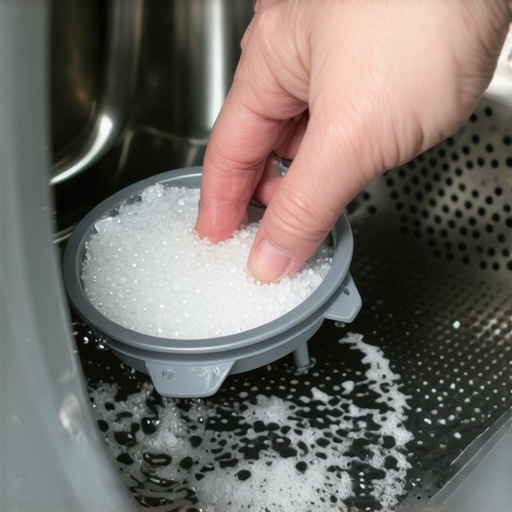
Run a High-Heat Reset to Melt the Build-Up
If your washer is already smelling funky, a cold ‘Eco’ wash won’t save it. You need to blast that ‘scrud’ with heat. Most modern machines have a dedicated tub-clean cycle, but if yours doesn’t, set it to the highest temperature possible. High heat is the only way to melt the fatty acids found in fabric softeners. I have found that using the ‘Steam’ function if your model has it, is incredibly effective at penetrating the grime behind the drum. If you aren’t sure how to activate these features, checking out how to use steam cycles on your smart washer can provide the deep clean you need without harsh chemicals.
Scrub the Gasket Without Damaging the Seal
The rubber bellows (the gasket) at the front of your machine is prime real estate for mold if you use too much softener. Take a microfiber cloth soaked in a mixture of vinegar and water and run it through every fold of that rubber. You will likely pull out a handful of grey gunk. Knowing how to clean a front-load washer gasket without using bleach is vital because bleach can actually degrade the rubber over time, leading to leaks. Once I started doing this monthly, the ‘gym sock’ smell disappeared for good.
You have probably heard the cynical rumor that modern appliances are simply ‘made to break.’ While it is true that why modern refrigerators don’t last as long as your grandmas involves more complex electronics, the real culprit is often how we interact with the technology. We treat our high-tech machines like the mechanical tanks of the 1990s, and that is a recipe for a service call. Let’s dig deeper into the nuances that even ‘pro’ homeowners get wrong.
The Big Lie About Eco Modes and Performance
Everyone tells you that ‘Eco’ modes are just a marketing gimmick to satisfy government regulators, but in my experience, the opposite is true. Most users avoid these settings because they take three hours instead of one. They assume a longer cycle means more wear and tear. However, according to the Association of Home Appliance Manufacturers (AHAM), these longer cycles are actually gentler. They use lower temperatures and less aggressive mechanical action, relying on ‘dwell time’ for enzymes in your detergent to chemically break down stains. If you are constantly bypassing these for the ‘Quick Wash,’ you are actually putting more stress on the motor and heating element. This is often the best energy saving modes on your new dishwasher because it prioritizes efficiency over raw speed.
Why does the timer on your smart washer keep jumping around?
It is the number one complaint I hear: ‘The machine said ten minutes left, but it stayed there for half an hour!’ This isn’t a glitch; it is the machine’s AI trying to save itself. Modern units use turbidity sensors to ‘see’ how much soap or dirt is left in the water. If you used too much softener—as we discussed earlier—the machine detects those bubbles and adds extra rinses automatically. This is exactly why your high-efficiency washer takes so long to complete a load. It isn’t ‘broken’; it is fighting the ‘scrud’ you accidentally created. If you find your machine constantly recalculating, it is a sign your detergent dosage is way off.
The Quick Cycle Trap You Need to Avoid
Here is a contrarian take: The ‘Quick Wash’ or ‘Express’ setting should be your last resort, not your daily go-to. While it feels efficient, these cycles rarely reach the temperatures needed to kill bacteria or fully dissolve the fats found in modern detergents. Over time, relying on fast cycles leads to a massive buildup of sludge in the outer drum. I’ve found that users who run at least one ‘Sanitize’ or high-heat cycle a week have machines that last years longer. Understanding washing machines that save water means realizing that water volume isn’t the only factor; temperature and time must compensate for that lack of water. If you don’t give the machine time, you’re just moving dirt around.
We also see this in the kitchen. Many people think they are saving their fridge by packing it tight, but 5 mistakes that are shortening the life of your smart refrigerator often start with blocked airflow. Your ‘smart’ fridge needs to breathe to keep the compressor from overworking. If you’ve ever wondered why your refrigerator compressor is cycling too often, check if you’ve shoved a giant carton of milk right in front of the air thermistor. Have you ever fallen into this trap? Let me know in the comments. We’re all learning how to live with these ‘genius’ machines without losing our minds—or our deposit money.
I’ve spent a lot of time talking about the ‘gunk’ and the ‘scrud,’ but let’s move away from the chemistry and talk about the physics of your laundry room. I once lived in an old farmhouse with a floor that had a slight, almost imperceptible slant. My smart washer sounded like a freight train every Tuesday. I ignored the racket until the drum started to wobble like a loose tooth. This wasn’t just a nuisance; it was mechanical suicide. I finally bought a $15 torpedo level and spent twenty minutes actually adjusting the legs. It changed everything. If you skip this basic step, you are essentially fast-tracking a service call. You absolutely must know how to stop your washing machine from banging against the wall because that physical stress is what shreds the internal dampers. Ignoring these vibrations is the fastest way to reach the point where you have to learn how to tell if your washer bearings are about to fail—and believe me, once those bearings go, the repair cost often rivals the price of a new unit.
Software Is the New Spare Part
I used to laugh at the idea of ‘updating’ my refrigerator. Why does a box that keeps my milk cold need a software patch? Then my smart ice maker started acting possessed, dumping ice at 3 AM for no reason. It turns out, a bug in the initial code was misreading the thermistor data. A five-minute firmware update via the app fixed it instantly. In the modern era, learning how to update the firmware on your smart kitchen appliances is just as important as changing an air filter. These machines are computers that happen to wash clothes or chill food, and the code needs to stay current to manage the delicate electronics inside. According to technical reports from the Electric Power Research Institute (EPRI), internal power surges from other large motors in your home, like an AC unit, are responsible for over 80% of ‘ghost’ errors in smart appliance control boards. Keeping your firmware updated ensures the machine has the latest logic to handle these voltage fluctuations without locking up.
#IMAGE_PLACE_HOLDER_D#
How do I maintain these complex systems without a degree in engineering?
The secret is to treat your appliances like a car rather than a toaster. You wouldn’t drive a car for 100,000 miles without an oil change, yet we expect dishwashers to run 1,000 cycles without a check-up. Beyond the software, you need to understand the mechanical differences in your kitchen. For instance, knowing the difference between inverter and traditional refrigerator compressors helps you realize why your new fridge doesn’t just ‘click’ on and off like the old ones. Inverters run at variable speeds, which is great for efficiency but makes them more sensitive to dust buildup on the condenser coils. I make it a habit to vacuum my fridge coils every six months. It’s a ten-minute job that can extend the life of that expensive compressor by years. Looking ahead at the future of home appliances trends to watch in 2025, we are moving toward ‘predictive maintenance’ where the machine will literally text you when a part is 10% away from failing. Until that becomes the standard, we have to be the brains of the operation. My advanced tip for you this week: Download a free ‘Bubble Level’ app on your smartphone, place it on the top of your washer while it’s empty, and ensure it’s perfectly level. It is the easiest five-minute fix to prevent a five-hundred-dollar repair.
The Expensive Lessons My Laundry Room Taught Me
After years of trial and error with high-end tech, I’ve realized that the ‘smart’ in smart appliances usually refers to the sensors, but the wisdom has to come from us. Here are a few lightbulb moments that saved me from calling a technician:
- The Pod Placement Error: I used to think I could just toss a detergent pod anywhere. In reality, if it gets caught in the door seal, it won’t melt. This is often why your dishwasher pod isn’t dissolving completely as well.
- Residue is a Warning: If you see white marks on your gym clothes, it’s not lint; it’s un-rinsed soap. This is a huge clue for why your high-efficiency washer is leaving white streaks on dark clothes.
- Software over Screwdrivers: Sometimes the ‘breakdown’ is just a bug. I always check for a digital patch before I assume a motor has died. These internal logic errors are becoming more common as our washing machines evolve into computers.
My Go-To Toolkit for a Glitch-Free Kitchen
You don’t need a heavy toolbox to keep things running; you just need the right habits. These are the three things I never live without for maintaining modern home appliances:
First, Distilled White Vinegar. It is the ultimate mild acid for breaking down the ‘scrud’ we talked about without hurting the internal seals. Second, a Smartphone Leveling App. Since even a tiny tilt can ruin your drum bearings, I use this every few months to ensure my machine hasn’t ‘walked’ out of alignment. Finally, the Manufacturer’s Home App. Keeping your phone synced is the only way to stay on top of how to update the firmware on your smart kitchen appliances effectively. If you are looking for more ways to integrate tech into your daily routine, check out the top smart appliances for a seamless home experience in 2025.
Taking Back Control of Your Smart Home
It’s easy to feel like these machines are high-maintenance divas, but once you understand their language, they really do make life easier. You don’t have to be an expert to have a home that runs smoothly. By just paying a little more attention to how much soap you use and keeping the software current, you’re already ahead of 90% of homeowners. Whether you are managing dishwashers or high-tech refrigerators, your journey into the ultimate guide to smart home appliances for a modern living starts with these small, daily wins. Have you ever found a ‘secret’ setting on your machine that actually changed how you do chores? Let me know in the comments below!