

I remember sitting on my kitchen floor last August, staring at a puddle of lukewarm water leaking from under my fridge. My Golden Retriever, Gus, was happily napping right next to the vent, totally oblivious to the fact that his lovely shedding coat was effectively suffocating our kitchen’s MVP. I had spent a small fortune on a high-end model, yet it sounded like a jet engine trying to take off. I felt like a failure. After a quick call to a technician who basically laughed at the ‘carpet’ of fur under my unit, I realized that choosing the right refrigerator is only half the battle; the real work is keeping it alive in a pet-friendly home. Today, I’m going to show you exactly how to tackle those grimy coils so you can avoid a massive repair bill and keep your milk from spoiling before the weekend.
Your Fridge Is Choking on Pet Hair and You Do Not Even Know It
Believe me, I used to think that a quick pass with the vacuum near the front was enough. I was wrong. My biggest mistake early on was assuming that because I could not see the coils, they must be fine. In a house with pets, those coils act like a high-powered magnet for dander and fur. This buildup forces the compressor to work overtime, which is usually why your refrigerator is making a loud humming noise late at night. According to the Department of Energy, dirty condenser coils can actually increase your refrigerator’s energy consumption by as much as 30 percent. That is a huge hit to your utility bill just for a bit of fluff. To start, you need to know how to clean the hidden debris under your refrigerator grille before you even think about the coils themselves.
Is cleaning the coils actually worth the hassle?
I get it. You have to pull the fridge out, get on your hands and knees, and deal with ‘dust bunnies’ that look more like small rodents. You might be wondering if this is just another chore invented by ‘Big Appliance.’ But here is the reality: neglecting this is the fastest way to kill your machine. In fact, learning the secret to making your refrigerator last twice as long almost always starts with airflow. When those coils are buried in fur, the heat has nowhere to go. It is like trying to run a marathon while wearing a parka. Have you ever pulled your fridge out and been absolutely horrified by what was living underneath it? I certainly was. It’s a bit of a reality check, but once you see the difference in your fridge’s performance, you’ll never skip it again. Let’s get into the nitty-gritty of the tools you actually need.
Cut the Power Before You Touch a Tool
I will never forget the time I tried to skip the ‘unplugging’ part. I thought I could just slide the fridge out a few inches while it was still humming away. Big mistake. I caught a wire on the floor trim, and the resulting spark was enough to make Gus hide under the bed for three hours. Now, I always make sure the power is dead before I even think about touching the coils. It is the first of several mistakes that are shortening the life of your smart refrigerator, and it is the easiest one to avoid. It only takes ten seconds to reach behind and pull that cord, but it saves your control board—and your heart rate—from a nasty shock. If you cannot reach the plug, flipping the breaker in your electrical panel is a perfectly fine alternative.
Hunt Down Those Grimy Coils
Once the power is off, you need to actually find where the heat exchange happens. Most modern units hide them behind a snap-off grille at the bottom front. If you have an older model, they might be a big black grid on the back. If you are moving a massive unit to get to the rear, you absolutely need to know how to move a heavy refrigerator without scratching the floor. I learned this the hard way when I left a three-foot scar on my oak flooring last spring. Now, I use cardboard or specialized glides to keep everything smooth. You want the fridge to move, not your floorboards. If your coils are at the bottom, use a flathead screwdriver to gently pop the plastic clips on the base grille so you do not snap them off.
The Brush and Vacuum Double Team
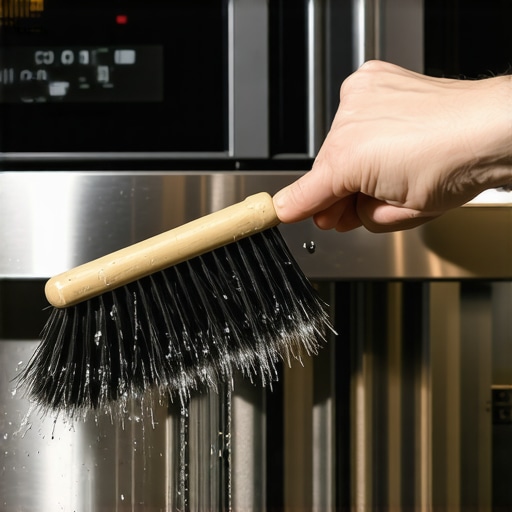
With the coils finally exposed, it is time for the ‘Satisfaction Phase.’ Grab a long-handled coil brush—they cost about ten bucks and look like a giant pipe cleaner. Shove it into the coils and wiggle it around. You will be horrified by the grey, felt-like mats of hair that come out. It is gross, but every clump you remove makes your kitchen more efficient. Follow up with a narrow vacuum attachment to suck up the loose debris. This is one of the hidden settings on your fridge that can save you money on utilities, even though it is a physical task rather than a digital one. Airflow is king. Think of it like a radiator in a car; when the air can circulate through the metal fins, the compressor does not have to strain, which is the main reason why your unit stays quiet and your electricity bill stays low.
Stop the Rocking Before You Finish
Before you shove everything back into place, take thirty seconds to look at the base. I have found that after moving the unit, it almost never sits perfectly flat. Learning how to adjust the feet on your refrigerator to stop it from rocking is the final touch that prevents those annoying rattles that sound like a ghost is living in your kitchen. While you are down there, check if your model has the secret drain filter at the bottom of your fridge. If that is clogged with Gus’s fur too, you will have a whole different set of water problems next week. A quick wipe-down of the floor where the fridge usually sits is also a pro move; it stops new dust from getting sucked right back onto the clean coils the moment you turn the power back on.
Your Fridge Running Constantly Isn’t Always a Bad Sign
Most people panic when they realize their new smart fridge is humming along for eighteen hours a day. They assume it is struggling to keep up, but here is a contrarian reality: it is actually designed to stay in motion. Unlike the old ‘on-off’ clunkers from the 90s, modern units use inverter compressors that stay on at a low, energy-saving speed. If you are wondering why your high-efficiency fridge runs more often than your old one, it is because maintaining a steady temperature is far more efficient than the massive power spikes required to start a heavy motor from a dead stop. According to research from the Association of Home Appliance Manufacturers (AHAM), these variable-speed motors can reduce overall energy consumption by up to 25 percent despite their longer run times. Thinking your fridge is ‘broken’ just because it is quiet and persistent is one of the most common myths I see from homeowners today.
Why does your high-efficiency fridge run more often than your old one?
It comes down to the science of thermal management and sensor sensitivity. When you open the door to grab a snack, the smart sensors detect even a one-degree fluctuations and calculate exactly how much ‘work’ is needed to stabilize the cabinet. If you keep the fridge at its coldest possible setting thinking you are helping, you are actually forcing the inverter to stay at peak RPM for hours, which is one of the major mistakes that are shortening the life of your smart refrigerator. I’ve seen people crank the dial to ‘max cold’ in July and then wonder why their unit fails by year five. The sweet spot is usually 37 degrees Fahrenheit; any lower and you are just burning through your compressor’s lifespan for no actual benefit to your groceries.#IMAGE_PLACE_HOLDER_C#
The Software Glitch That Looks Like a Mechanical Failure
I once visited a neighbor who was ready to junk a high-end French door model because the ice maker stopped and the screen went dark. She was convinced the compressor was shot and the repair would cost more than a new unit. In reality, the ‘brain’ had simply hung during a background update. Many owners do not realize there is the hidden reset button on your smart refrigerator that fixes glitches without needing a $200 service call. This is the ‘Oops’ factor of the digital age—we assume a black screen or a frozen interface means a dead appliance. Before you call a tech, you should always attempt to how to hard reset your smart refrigerator control panel. Often, a simple power cycle or a button combo restores every function, saving you from a massive, unnecessary replacement bill.
Don’t Treat Your Touchscreen Like a Kitchen Counter
Here is an advanced warning I give to every pet owner: stop using heavy-duty chemical cleaners or glass sprays near the control sensors. I know the temptation is high to scrub away the nose prints and fur that accumulate on the door, but if moisture seeps into the bezel of that screen, you will eventually find why your smart fridge screen keeps going black every morning. The capacitive layers are incredibly sensitive to pH changes in cleaning fluids. Use a dry microfiber cloth and perhaps a tiny bit of distilled water, nothing more. Have you ever fallen into this trap of over-cleaning or panic-resetting your tech? Let me know in the comments below, because I have definitely been there myself. In the end, deciding is a smart fridge really worth the extra money often depends on whether you are willing to maintain the software as carefully as you maintain the hardware.
If you think the refrigerator is the only thing in your kitchen working overtime, take a look at your laundry room. Last month, my front-loader started emitting a scent that I can only describe as ‘wet swamp meets old gym locker.’ It turns out that I had been completely ignoring the small access door at the bottom of the unit. This is where the magic (and the mess) happens. I found three hair ties, a very soggy nickel, and enough lint to knit a small sweater. Learning how to clean the lint filter you didn’t know your washer had isn’t just about hygiene; it is about preventing the pump from burning out. When that filter is blocked, the machine has to work twice as hard to drain, which is often the reason your high-efficiency washer smells like old gym socks. I now keep a dedicated ‘grime kit’ in my laundry cabinet: a flexible bottle brush, a small bucket for the emergency drain hose, and a pack of citric acid cleaner.

How do I maintain my smart appliances over time?
Consistency beats a deep clean every single time. For my dishwasher, I’ve moved away from the ‘wait until it smells’ strategy. I now perform a five-minute check every Sunday. I pull out the bottom rack and check the filter area for seeds, bits of plastic, or bone fragments. If you see liquid sitting there, you need to investigate why your dishwasher still has standing water in the filter area before it turns into a mold factory. According to the official service guidelines from Miele’s technical documentation, maintaining a clean door seal is just as critical as the internal spray arms. I use a soft microfiber cloth to how to deep clean the gasket on your dishwasher to prevent leaks, ensuring no debris is compromising the vacuum seal. It takes seconds, but it prevents that slow drip that eventually rots your subfloor.
The Tools That Saved Me a $300 Service Call
I am a firm believer that every smart home owner needs a ‘non-smart’ toolbag. Beyond the standard screwdrivers, I highly recommend a 12-inch flexible grabber tool. I used mine last week to retrieve a piece of silverware that had fallen into the dishwasher sump and was making a horrific grinding noise. Without it, I would have been looking at a massive repair bill for a ‘broken’ pump. This proactive approach is the core of any ultimate guide to smart home appliances for a modern living. We buy these machines for convenience, but we often forget that they are still mechanical beasts at heart. If you can clear a block or tighten a loose foot, you are already ahead of 90% of homeowners.
The Future of Self-Diagnosing Steel
Looking ahead, I predict a massive shift in how we handle these chores. As we look toward the future of home appliances: trends to watch in 2025, we are going to see ‘predictive maintenance’ sensors become standard. Instead of finding a puddle, your washer will likely send a push notification to your phone saying, ‘Hey, your pump flow is restricted by 15%; clean the filter today to avoid a failure.’ We are moving from reactive repairs to proactive care. Until then, you have to be the brain of the operation. My best advice? Go pull the bottom panel off your washing machine right now. If you haven’t touched it in a year, I promise you’ll find something that shouldn’t be there.
The Toughest Lessons I Learned While Tinkering with My Kitchen
After years of managing a household full of high-tech gear, I have realized that consistency is more valuable than any extended warranty. My first big mistake was trusting the ‘smart’ part of the name too much; just because a machine has a screen does not mean it can clean its own internals. I have also learned that silence is often a warning—if you stop hearing the gentle hum of your fridge, it might not be efficient; it might be failing. Lastly, always document your victories. I keep a small notebook inside a kitchen cabinet to track when I last tackled the coils or flushed the washer. This simple habit is the core of any ultimate guide to smart home appliances for a modern living because it removes the guesswork from maintenance. It turns a chore into a predictable routine that saves your sanity.
The Low-Tech Tools That Keep High-Tech Machines Happy
You do not need a degree in engineering to keep things running, but you do need the right gear. I swear by a long-reach flexible coil brush for the fridge and a small dental mirror to peek into dishwasher spray arms without removing them. I also keep a digital folder of every manual on my phone; searching for how to reset the error codes on your modern smart washer is much easier when you are not digging through a junk drawer for a paper booklet. Finally, a basic non-contact voltage tester is essential. It tells you if the power is truly off before you start cleaning, providing peace of mind while you work on your choosing the right refrigerator journey through its lifespan.
Take Charge of Your Modern Home Today
It is easy to feel overwhelmed by the complexity of 21st-century kitchens, but remember that every machine is essentially just a series of parts designed to make your life easier. By taking ten minutes a month to check a filter or brush away some pet hair, you are ensuring the future of home appliances: trends to watch in 2025 includes a working unit in your own home rather than one in a landfill. You have the tools and the knowledge now—do not be afraid to pull that fridge out and see what is going on underneath. The sense of accomplishment you feel when that compressor kicks back on quietly is worth every bit of effort. Have you ever found a weird object like a toy or a lost coin in your appliance filter that definitely should not have been there? Let me know in the comments below!