
I’ll never forget the first time I hosted a dinner party after upgrading my kitchen. I felt like a pro standing next to my matte-black masterpiece. Then, the morning sun hit the door at just the right angle, revealing a horror show of oily palm prints and ghostly streaks that my quick wipe had only smeared around. I felt like a total fraud. I’d spent all this money on a premium look, yet it looked like a greasy chalkboard under the light. If you’ve ever stood there with a microfiber cloth in one hand and tears in your eyes, wondering why your smudge-proof appliance looks like a crime scene, I hear you. It is a frustrating realization that the high-end look comes with high-maintenance fears. Today, I’m going to share exactly how I saved my fridge from my own bad cleaning habits and how you can get that showroom shine back without ruining the delicate finish.
Stop Reaching for That Harsh Chemical Spray
When I first brought my fridge home, I treated it like my old chrome-heavy models. Big mistake. I grabbed a bottle of heavy-duty degreaser and a scouring pad to tackle some dried-on soup. Within seconds, I realized I was stripping away the very coating that gives black stainless its unique luster. Unlike traditional steel, this finish is often a thin polymer coating over the metal. According to experts at Consumer Reports, using abrasive cleaners or bleach can permanently damage these specialized finishes, leading to peeling or discoloration that no amount of buffing can fix. If you’re currently choosing the right refrigerator, you need to know that the maintenance routine is a totally different ballgame compared to standard silver. I learned the hard way that less is almost always more. Have you ever accidentally used a generic glass cleaner only to find it left a weird blue haze? It’s a gut-wrenching feeling when you think you’ve ruined a multi-thousand-dollar appliance.
Is black stainless steel actually harder to maintain than regular metal?
It’s the question every neighbor asks me when they see my kitchen. People fear that one wrong move will leave a permanent scar. While it is technically more sensitive to scratches—you might want to check out the easiest way to remove scratches from stainless steel appliances if you’ve already had a mishap—it’s not necessarily harder to clean; it just requires a specific strategy. Have you ever felt like you were accidentally scrubbing the color right off your fridge? It’s a common panic moment. The truth is, once you stop treating it like a cast-iron skillet and start treating it like a piece of high-end electronics, the stress disappears. We often make 5 mistakes that are shortening the life of your smart refrigerator, and aggressive cleaning with the wrong tools is at the top of that list. My goal today is to give you a fool-proof, gentle method that keeps the fingerprints at bay for more than five minutes without the need for expensive, specialty chemicals.
The Gentle Routine That Actually Works
Once I realized that my fridge was essentially wearing a delicate coat of polymer rather than being solid-colored metal, my entire perspective changed. Think of it like the screen on your smartphone or the clear coat on a luxury car. You wouldn’t take a scouring pad to your iPhone, right? The key to maintaining that deep, charcoal glow is a process I call the ‘Minimalist Wipe.’ I remember the Saturday morning I decided to go ‘all in’ on a deep clean. I bought three different brands of stainless steel wipes. By noon, my fridge looked like it had been smeared with bacon grease because those oil-based products just sit on top of the coating instead of cleaning it. I had to start from scratch with the method I’m about to give you.
Clear the Dust Before It Becomes Sandpaper
This is the step everyone skips, and it’s the reason most fridges end up with those tiny, swirling micro-scratches. Before you ever introduce moisture, you have to remove the dry debris. Dust particles are surprisingly abrasive. If you spray a liquid and start rubbing immediately, you’re just grinding those tiny rocks into the finish. I use a clean, dry microfiber cloth and do a very light pass over the entire surface. If you’re lucky enough to have one of the best smart fridges for families who love to meal prep, you’ll notice that the flat panels show dust even more than the older textured ones, so don’t be lazy here. Just a ten-second dusting can save you years of finish degradation.
Why Simple Dish Soap Beats Specialized Polishes
After the dust is gone, you only need two things: warm water and a single drop of mild dish soap. I keep a dedicated spray bottle for this. The goal isn’t to soak the appliance; it’s to break down the oils from your fingertips. I’ve seen people use glass cleaner thinking it’s safe, but the ammonia can eat through the protective layer over time. When I switched to the soap-and-water method, the ‘haze’ I’d been fighting for months finally vanished. If you’re also managing other high-end kitchen gear, you might find that how to clean the hidden filter in your energy efficient dishwasher requires similar attention to detail—using the right, gentle tools is a universal rule for modern kitchens.
Wipe With the Grain or See the Scratches
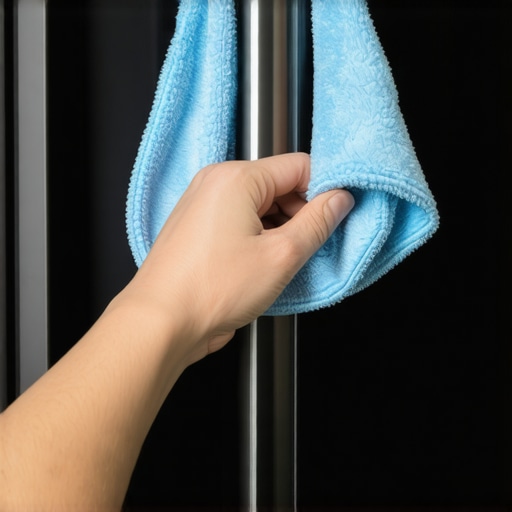
Even though black stainless steel is a coating, it still has a directional ‘grain’ from the metal underneath. You have to find it. Usually, it runs horizontally. If you wipe in circles, you’re fighting the physics of the finish. I learned this the hard way when I left a permanent swirl mark near the handle of my freezer. Now, I move my hand in long, steady strokes from left to right. This ensures that any microscopic marks are hidden within the natural texture. This level of care is similar to how you’d handle a delicate wash cycle; knowing the best settings for washing your heaviest winter bedding is all about protecting the fibers, and wiping with the grain is about protecting the steel’s ‘skin.’
Protect the High-Tech Components
Most of these fridges come with massive LCD panels. Be incredibly careful here. If you spray your soap solution directly onto the screen, it can drip down into the electronics. This is a common reason why your smart fridge touchscreen is unresponsive. Always spray your cloth, not the fridge. I once had a scare where the screen started flickering because I got a little too aggressive with a wet rag near the bezel. Now, I treat the screen like a laptop monitor—barely damp and buffed dry immediately. If you’ve already set things up so you know how to set up your smart refrigerator to alert you when the door is ajar, the last thing you want is a dead screen preventing you from clearing those alerts.
We often assume that paying a premium for ‘smart’ technology means the appliance will take care of itself. In my experience, the opposite is true. While these machines offer incredible convenience, they are also more temperamental than the mechanical beasts our grandparents owned. For instance, you might wonder why your high efficiency washer takes so long to complete a load compared to your old unit. It is not a glitch; it is the machine’s complex sensors trying to balance water usage and fabric care in real-time. The hidden nuance here is that ‘Smart’ does not mean ‘Self-Sufficient.’ Treating a computerized fridge like a simple ice box is the fastest way to a service call.
Why Your ‘Smart’ Appliance Needs a Human Touch
Many homeowners fall into the trap of thinking sensors replace common sense. I have seen countless neighbors complain about their connectivity when the issue was actually physical placement. If your router is tucked behind a metal cabinet, you will constantly struggle with why your smart home app can’t find your dishwasher. It is often a signal interference issue, not a hardware failure. We keep making these 5 mistakes that are shortening the life of your smart refrigerator by treating high-tech gear with low-tech habits.
Is skipping a firmware update actually risky for your kitchen?
Many users treat their fridge or dishwasher like a toaster—plug it in and forget about it. However, when you own smart home appliances for a modern living, you are essentially maintaining a computer that happens to chill milk or wash plates. I have seen perfectly good units become glitchy nightmares simply because the owner ignored a critical patch. Knowing how to update the firmware on your smart kitchen appliances is just as important as cleaning the lint trap. 
The hidden danger of the over-sudsing habit
Here is a contrarian take: most people are using way too much soap, and it is destroying their machines. We have been conditioned to think that more bubbles equal more clean. However, the Association of Home Appliance Manufacturers (AHAM) notes that modern HE machines are designed to function in high-pressure, low-suds environments. Excess soap creates a ‘suds lock’ that forces the motor to work twice as hard, leading to premature wear on the bearings. I have found that learning why your washer doesn’t need a whole cup of detergent to get clothes clean is the single most important lesson for longevity. If you see white streaks on your dark clothes, you are likely over-pouring, not under-rinsing. Have you ever fallen into this trap of over-soaping or ignoring the ‘Update’ button? Let me know in the comments.
Stop the Mineral Creep Before It Kills Your Pump
I learned the hard way that even the most expensive smart dishwasher is no match for the invisible minerals in my local water supply. For months, I was frustrated by why your dishwasher leaves a chalky film on your coffee mugs. I thought it was a sensor issue, but it was actually calcium buildup choking the spray arms. If you live in an area with hard water, you need a dedicated descaler. I personally use a citric-acid-based cleaner once a month because it is less abrasive than vinegar but strong enough to melt away the scale. This is especially vital if you have the best dishwashers for hard water areas; even they need a helping hand. According to technical documentation from the Department of Energy, mineral scale can reduce appliance efficiency by as much as 30%, which completely negates the point of having an Energy Star-rated machine. If you are seeing spots, check out the best way to remove hard water spots from dishwasher interiors before the buildup reaches your internal pump.
Why a Five-Dollar Smart Plug Is My Secret Weapon
You might think it is overkill to plug a smart appliance into a smart plug, but hear me out. My fridge tells me how much energy it uses, but it does not always tell me why it is spiking. By using the best smart plugs for monitoring appliance energy use, I found out that my fridge was working overtime because the condenser coils were packed with pet hair. The fridge’s internal app did not catch the efficiency drop, but the external plug’s data did. It is a level of granularity that helps you spot a failing compressor months before it dies. This kind of data-driven maintenance is exactly where the future of home appliances trends to watch in 2025 are headed. We are moving toward a world where your kitchen does not just tell you the door is open, but predicts hardware failure before you lose a hundred dollars in groceries.

How can I keep my smart kitchen running like new for the next decade?
The secret is not just cleaning; it is calibration. Most people do not realize that sensors can drift over time. Once a year, I manually verify my fridge’s temperature. If you do not, you might find your lettuce turning into icicles, which is why I wrote about how to calibrate your refrigerator thermometer without calling a pro. For your laundry room, longevity is about preventing the dreaded smell that plagues high-efficiency units. I always tell my friends to look into 3 reasons your energy efficient washer smells like damp. If you can keep the seals dry and the filters clear, these machines will easily outlast their warranties. I also recommend diving into innovative dishwashers with AI technology you must know because many of them now include self-cleaning cycles that are far more effective than the short cycles we all rely on too heavily.
My big prediction? In the next few years, we will see edge computing for appliances, where your washer analyzes the specific chemical makeup of your local water to adjust detergent dosing automatically. For now, you have to be the brain. **My challenge for you this weekend:** Go find your dishwasher’s hidden filter—the one you have probably never touched—and give it a scrub. You will be shocked at what has been sitting there, and your machine will sound quieter almost instantly.
The Hardest Lesson I Learned About Protecting My Modern Kitchen
Reflecting on my journey from a panicked homeowner with a streaky fridge to someone who actually understands the ‘why’ behind maintenance, I have realized that the biggest myth is that high-tech means high-durability. It is actually the opposite. These machines are sophisticated instruments. One major lightbulb moment for me was realizing that modern finishes do not need ‘polishing’—they need ‘preserving.’ If you are looking at top smart appliances for a seamless home experience in 2025, remember that the thin polymer coatings are your friend, but only if you treat them with the respect they deserve. Another hard truth? Your machine cannot tell you everything. While how smart washing machines can simplify laundry day is a huge selling point, they still rely on you to clear the physical blockages that sensors might miss until it is too late.
My Essential Toolkit for a Stress-Free Smart Home
I do not believe in buying every specialty chemical on the shelf. Instead, I rely on a few high-quality basics that I have tested across multiple units. First, a set of 400GSM microfiber cloths is non-negotiable; they are soft enough for the most sensitive black stainless but thirsty enough to dry surfaces without streaks. Second, I keep a stash of citric acid for descaling. It is far more effective and less pungent than vinegar for maintaining washing machines that save water, which are prone to mineral buildup. Finally, I always have a small soft-bristled brush—even an old toothbrush—to get into the crevices of seals where mold loves to hide. These simple tools are all you really need to keep your home running like a showroom.
Give Your Appliances the Care They Deserve
At the end of the day, your home is your sanctuary, and these appliances are the workhorses that make your life easier. Taking twenty minutes a month to perform these gentle maintenance tasks is not just about aesthetics; it is about protecting your investment and ensuring your refrigerators in 2025 continue to perform at peak efficiency. Don’t be afraid to get hands-on with your tech. The more you know about the physical needs of your smart appliances, the less likely you are to face a mid-week breakdown. Have you ever discovered a hidden filter or a cleaning trick that completely changed how you view your kitchen? Let me know in the comments below!