
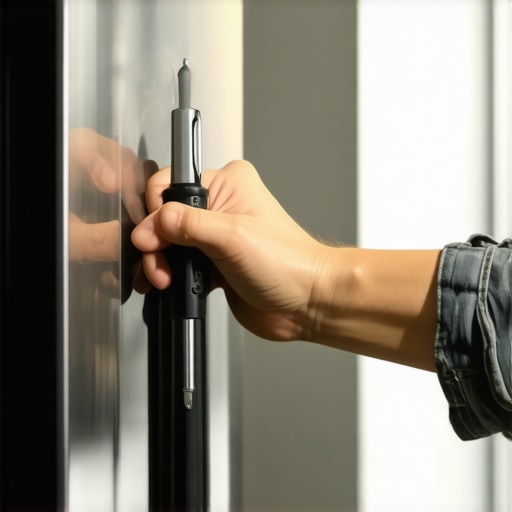
I was reaching for the half-and-half at 6 AM, barely awake, when it happened. That sickening, metallic thunk. My sleek, beautiful stainless steel refrigerator handle didn’t just give a little; it practically pivoted in my hand. It’s a visceral kind of frustration, isn’t it? You spend thousands choosing the right refrigerator only for it to feel like it’s held together by wishful thinking and cheap plastic. A loose handle makes the whole kitchen feel slightly unraveled, like a loose thread on a suit. Every time you go for a snack, you’re reminded that something isn’t quite right.
That Wobbly Handle is Driving You Crazy
I’ll be honest with you—years ago, I made a classic rookie move that still makes me cringe. I thought the handle mounting point was stripped, so I tried to ‘reinforce’ it with industrial-strength adhesive. Please, learn from my shame: don’t do that. It was a sticky disaster, it didn’t hold for more than a day, and I ended up searching for the easiest way to remove scratches and glue residue from my door for three whole days. It was one of those mistakes that shorten your appliance’s life—or at the very least, your patience. But here is the good news: fixing a loose handle is actually incredibly simple once you know where the set screws are hiding. We are going to get that handle rock-solid today without a $150 service call or a week-long wait for a technician.
Is a Loose Handle Actually a Sign of a Cheap Fridge?
You might be wondering if you bought a lemon or if your brand isn’t as reliable as the brochure claimed. The short answer is no. According to Consumer Reports, even top-tier French-door models frequently experience loose handles due to the sheer amount of force we apply to those heavy, vacuum-sealed doors every single day. It is a mechanical reality of refrigerators in 2025 that the constant tugging eventually backs out the fasteners. Have you ever felt like your fridge was literally falling apart in your hands when all you wanted was a glass of water? You aren’t alone, and it’s usually not a sign of a failing compressor or a major defect. [IMAGE_PLACEHOLDER]
Why Screws Go Rogue in the First Place
Most modern stainless steel handles are held on by tiny ‘set screws’—usually hidden on the underside or the side of the handle base. These screws bite into a mounting stud attached to the door. Over time, the vibration of the compressor and the daily ‘yank’ to get to the leftovers causes these screws to lose their grip. It starts as a tiny, almost imperceptible wiggle. If you ignore it, that wiggle turns into a clunk, and eventually, the handle can pop off entirely. I’ve seen it happen at the worst possible times—usually when someone is carrying a heavy glass pitcher or a tray of hors d’oeuvres. Setting the stage for a permanent fix isn’t just about tightening; it’s about understanding how the mounting bracket interacts with the handle skin itself. If we don’t seat it properly, you’ll be back here in two weeks doing the same thing. Let’s make sure that doesn’t happen.
Grab the Right Tools for the Job
To get started, you don’t need a heavy-duty toolbox. In fact, most refrigerator handles are secured by tiny hex-head set screws. You will need a set of Allen wrenches (also known as hex keys). Most major brands utilize a 1/8-inch or 3/32-inch size. Think of this process like leveling your laundry setup; just as you’d follow the most-reliable washing machine brands for durability tips to keep your machine from walking across the floor, you need the exact right fit here to prevent stripping the metal. I once tried to use a tiny flathead screwdriver to ‘wedge’ into a hex screw on a high-end French door model. It was a disaster. I ended up rounding out the screw head so badly that I had to drill the whole thing out. It was one of those 5 mistakes that are shortening the life of your smart refrigerator—or at least my sanity—and I spent the next hour researching the easiest way to remove scratches from stainless steel appliances after my screwdriver slipped.
Locate the Hidden Fasteners
Open your refrigerator door and look at the side of the handle where it meets the stainless steel skin. On most modern designs, you’ll find a small hole on the interior-facing side of the handle or underneath the bottom curve. This is where the set screw lives. If you have a model where the handle seems to ‘clip’ on without visible screws, you might be dealing with a slide-and-lock system. This is common when you how to change the door swing on your refrigerator, as the handles must be easily reversible. Insert your Allen wrench into the hole. You should feel it seat firmly. Give it a firm clockwise turn. If the screw is missing, don’t panic; these are standard parts you can find at any hardware store, though you might want to check refrigerators in 2025 top features to see if your specific smart model uses a proprietary magnetic clip instead.
Inspect the Mounting Studs Beneath the Skin
If you tighten the set screw and the handle still feels like a loose tooth, the problem isn’t the handle—it’s the mounting stud. These are the small metal ‘nubs’ protruding from the door that the handle grips onto. Over time, the screws holding these studs to the door can also vibrate loose. This is very similar to the mechanical fatigue seen when you how to replace a broken handle on your washing machine. To fix this, you must remove the handle entirely by loosening the set screws all the way. Once the handle is off, use a Phillips-head screwdriver to tighten the mounting stud directly into the door frame. Ensure they are flush and not cross-threaded. A tiny drop of blue thread-locker on these screws can ensure they never move again, even if you have a house full of teenagers who treat the fridge door like a gym pull-up bar. This attention to detail is what separates a quick fix from a permanent solution in a modern kitchen.
I often hear homeowners argue that if a handle comes loose, the appliance must be low-quality. But here is a contrarian truth: a handle that gives slightly under extreme stress might actually be saving your door. In my experience, manufacturers often design these mounting points as the ‘weakest link’ intentionally. If the handle didn’t wiggle, the force of a sudden yank might instead warp the thin, expensive stainless steel door skin itself. Repairing a set screw is a five-minute job; replacing a creased door panel is a five-hundred-dollar nightmare. This is why why modern refrigerators don’t last as long as your grandma’s steel-tank models—they are built with different mechanical tolerances that prioritize weight and energy efficiency over brute force.
The ‘Gorilla Torque’ Trap You Need to Avoid
The biggest mistake I see DIYers make is what I call ‘Gorilla Torquing.’ You get the Allen wrench in there, and you turn it until your knuckles turn white. Stop. Modern appliances use aluminum or soft-alloy mounting studs. If you over-tighten that tiny set screw, you’ll strip the threads inside the handle or, worse, shear the head off the screw. According to technical bulletins from the Association of Home Appliance Manufacturers (AHAM), mechanical fasteners on household units should only be tightened to ‘snug plus a quarter turn.’ Anything more risks permanent deformation of the mounting bracket. This same logic applies when you are learning how to replace a broken handle on your washing machine; precision beats power every single time.
Why does my brand new fridge feel flimsier than my grandmother’s?
It’s a question that keeps appliance forums buzzing. The reality is that refrigerators in 2025 use much thinner gauge metal to meet strict insulation and weight requirements. This thinner skin means that the mounting hardware has less ‘meat’ to grab onto. If you find yourself constantly tightening things, you might need to how to calibrate your refrigerator thermometer and check the door seal. A vacuum-locked door—caused by a temperature differential that’s too high—creates an incredible amount of resistance, forcing you to pull harder and loosening the handle faster than normal. It’s a chain reaction of 5 mistakes that are shortening the life of your smart refrigerator that most people never even notice.
Don’t Ignore the Micro-Vibrations
We often forget that our kitchens are active mechanical zones. Between the dishwasher’s pump and the fridge’s compressor, there is a constant ‘hum’ that acts like a slow-motion jackhammer on your screws. If you’ve invested in the ultimate guide to smart home appliances for a modern living, you know that tech can’t solve physics. I always recommend a tiny dab of blue (removable) thread-locker on the set screw. It’s a pro-level nuance that prevents vibration-induced loosening without making the screw permanent. Have you ever fallen into this trap of over-tightening a screw only to hear that dreaded snap? Let me know in the comments below, and let’s save some door skins together.
Why a Precision Hex Driver Beats Your Junk Drawer Set
If you’re still using that cheap, L-shaped Allen wrench that came in a flat-pack furniture box, you’re doing your high-end kitchen a disservice. I personally switched to a Wera Kraftform Kompakt hex driver set last year, and the difference is night and day. The ergonomic handle allows you to feel the exact moment the set screw bites, which is crucial for preventing the ‘Gorilla Torque’ I mentioned earlier. When you’re managing the ultimate guide to smart home appliances for a modern living, having tools that respect the delicate nature of aluminum threads is a must. These precision drivers often feature laser-etched tips that ‘bite’ into the screw head, ensuring you don’t slip and scratch that beautiful finish—a problem I’ve spent way too much time fixing with the easiest way to remove scratches from stainless steel appliances in the past.
How do I keep my appliance handles tight for a decade?
The secret isn’t in how hard you pull; it’s in the ‘annual snug-down.’ Every January, while I’m deep-cleaning the coils to ensure no one has to ask why your refrigerator compressor is cycling too often, I take my hex driver and give every handle in the kitchen a quick check. This proactive approach stops micro-vibrations from ever getting a foothold. According to the Sub-Zero & Wolf Technical Service Manual, fasteners on heavy-duty refrigerator doors are rated for specific torque ranges—often between 20 and 30 inch-pounds—and checking them annually prevents the gradual ‘oval-ing’ of the mounting holes, a structural failure that eventually necessitates a total door replacement. It is much easier to maintain a connection than it is to repair a warped metal skin.
Stop the Wiggle with a Single Drop of Blue Liquid
If you want to never think about this repair again, get a tube of Loctite Threadlocker Blue 242. Do not—I repeat, do not—use the Red version, as that requires a blowtorch to remove. A single tiny drop on the threads of that set screw acts as a semi-permanent shim. This is a game-changer for those who have invested in refrigerators in 2025 top features, where handles are often larger and more prone to leverage-based loosening. The liquid fills the microscopic gaps between the threads, locking the screw in place against the daily vibration of the motor while still allowing you to remove it with hand tools if you ever need to learn how to change the door swing on your refrigerator. It’s the ultimate ‘set it and forget it’ hack for the modern kitchen.
The Shift Toward Smart Doors and Modular Grips
Looking ahead at the future of home appliances trends to watch in 2025, we are seeing a move away from mechanical fasteners altogether. Some high-end brands are already experimenting with electromagnetic locking handles that only engage when they sense a human hand, and modular ‘snap-fit’ grips that use high-tension polymer clips instead of screws. My prediction? Within five years, we’ll see ‘haptic handles’ that alert your phone if they detect mechanical looseness before it becomes a physical wobble. If you’re ready to level up your DIY game, I challenge you to try the blue threadlocker trick on just one loose handle today—it is the single most effective way to make a mid-range fridge feel like a luxury unit. If you have any questions about specific tool sizes or thread types for your model, feel free to contact us and I’ll help you troubleshoot your specific setup.
The Hidden Reality of Kitchen Hardware Fatigue
After years of tinkering, I’ve realized that a loose handle is rarely a manufacturing defect; it’s a symptom of the ‘invisible’ physics in our homes. First, vibration is the enemy. The constant cycle of the compressor is like a slow-motion screwdriver working in reverse. Second, the ‘yank’ we use to break the vacuum seal on a modern French-door model puts hundreds of pounds of pressure on those tiny set screws over a year. Finally, I’ve learned that ignoring a wiggle is the most expensive mistake you can make. A loose screw eventually ovals out the mounting hole in the door skin, turning a five-cent fix into a five-hundred-dollar door replacement. This is why choosing the right refrigerator involves looking at the handle mounts as much as the interior volume.
The Maintenance Kit I Keep in My Kitchen Drawer
You don’t need a professional workshop to keep your kitchen in top shape. I personally swear by a few specific items: Precision Hex Drivers (avoid the cheap, L-shaped keys that come in the box), Blue Threadlocker (the ‘magic juice’ for a permanent fix), and a high-quality Microfiber Cloth to protect the finish while you work. If you are curious about the future of home appliances trends to watch in 2025, you’ll see more maintenance becoming digital, but for now, these mechanical essentials are your best friends. I also recommend keeping a digital copy of your manual in the cloud so you never have to hunt for torque specs again. [IMAGE_PLACEHOLDER]
Take Back Control of Your Daily Routine
Fixing that wobbly handle is about more than just mechanics; it’s about the feeling of a home that works for you, not against you. When your appliance feels solid, the whole experience of cooking and living in your kitchen improves. Don’t let a minor nuisance like a loose screw turn into one of those 5 mistakes that are shortening the life of your smart refrigerator. You’ve got the tools and the knowledge now—go ahead and tighten that handle today. In the world of refrigerators in 2025, being a proactive homeowner is the best way to ensure durability. Have you ever accidentally stripped a screw while trying to fix a loose handle? Share your ‘oops’ moment in the comments below!