
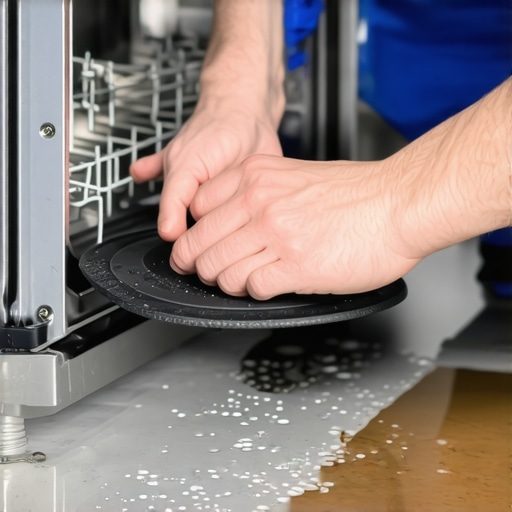
I stood there in my favorite wool socks, feeling that unmistakable, icy-cold squelch between my toes. It wasn’t a spilled glass of water, and it definitely wasn’t the dog’s fault. My dishwasher was weeping onto the hardwood floor like it had just finished watching a tragic movie. That sinking feeling—the one where you immediately start calculating the cost of a plumber or a brand-new unit—is a nightmare I’ve lived through more than once. But here’s the thing: you don’t need a degree in mechanical engineering or a thousand-dollar budget to stop the flood. Most of the time, the solution is much simpler than you think. Have you ever walked into your kitchen only to find your dishwasher has decided to treat your floor like a swimming pool? If so, you are in the right place because I’m going to help you dry those socks for good.
My Kitchen Became an Indoor Pool Last Tuesday
I remember years ago, I panicked at the first sign of a puddle and immediately started looking at innovative dishwashers with AI technology. I convinced myself the whole machine was “totaled.” I spent nearly a thousand dollars I didn’t have, only to find out later that the issue was a tiny piece of debris stuck in the door seal. Talk about a face-palm moment. I felt like a fool. These days, I’ve learned that a leaky door isn’t a death sentence for your appliance. Even if you are choosing the best dishwasher on the market, mechanical wear happens to everyone. Often, the culprit is just a dirty or misaligned gasket. If you’ve noticed why your dishwasher is making a grinding noise or leaving puddles, it’s usually a sign of neglect rather than a broken motor. Today, we are going to look at the grime, the seals, and the simple adjustments that keep the water inside where it belongs.
Is a home remedy actually going to last?
You might be skeptical that a “quick fix” is anything more than a temporary band-aid. I used to think the same way. I assumed that if I didn’t see a guy with a heavy tool belt and a clipboard, the job wasn’t done right. But here’s the reality: many manufacturers actually design these components to be user-serviceable. According to data from Consumer Reports, a significant percentage of appliance failures are actually maintenance issues that owners can handle themselves. Whether you’re following an ultimate guide to smart home appliances for a modern living or maintaining a ten-year-old workhorse, the principles are the same. I’ll show you the best way to clean your dishwasher door seal without tearing it and how to ensure everything is seated perfectly. We will also touch on how to prevent mold growth in your dishwasher seal, which is often the silent killer of watertight integrity. By the time we’re done, you’ll have the confidence to tackle this repair in less time than it takes to watch a sitcom rerun. Let’s get our hands a little dirty so your floors can stay dry.
Stop the Squelch without Calling a Pro
The first thing I do when I see a puddle is look at the “lips” of the machine—the rubber gasket that runs along the door. Think of this seal like the weather stripping on your front door. If it is brittle, cracked, or covered in old spaghetti sauce, water is going to find a way out. I once spent an hour chasing a leak only to realize a single piece of dried kale was propping the seal open just enough to let a stream of water escape. Most leaks are not mechanical failures but simple maintenance oversights.
Inspect the Rubber Seal First
You need to run your fingers along the entire length of the gasket. Feel for any gaps or hard spots. If the rubber feels more like hard plastic than a flexible band, it has likely lost its ability to compress against the door. To get things back in order, you should deep clean the gasket on your dishwasher to prevent leaks using warm, soapy water and a soft cloth. I remember one humid July when I ignored a tiny black speck on the seal; within weeks, it was a colony of mold that had compromised the rubber’s texture. Learning how to prevent mold growth in your dishwasher seal is half the battle in keeping your kitchen dry. If you find a tear, the gasket is user-serviceable; you can usually pull it right out of its channel and press a new one in with your thumb. #IMAGE_PLACE_HOLDER_B#
Check for Clogs in the Spray Arms
Sometimes the leak is not about a faulty seal at all, but about where the water is being aimed. A clogged spray arm is like a garden hose with your thumb over the end; it creates a high-pressure jet that can blast water directly past the lower door baffle. I have seen instances where a stray toothpick or a piece of broken glass got lodged in a nozzle, creating a “sniper” stream of water. This often happens if you do not know the best way to stack your dishwasher for maximum clean, leading to debris circulating through the system. If you have noticed why your dishwasher isnt cleaning the top rack properly, it is a sign that these arms are blocked and redirected water might be hitting the door at an angle the seal cannot handle.
Level the Machine on Uneven Floors
If your dishwasher is leaning forward even slightly, gravity will pull the water toward the door rather than the rear drain. It sounds too simple to be true, but an unlevel appliance is a primary cause of mysterious puddles. Just as you would level a washing machine on an old slanted floor, you must adjust the front feet of your dishwasher. I once helped a neighbor who was ready to buy a new unit, only to find their kitchen floor had settled over the years. We twisted the leveling legs two turns, and the “unfixable” leak vanished instantly. While you are down there, check the filter area to see why your dishwasher still has standing water, because a slow drain can cause water to back up and spill over the tub’s edge during a heavy rinse cycle. Making sure the water is moving where it is supposed to go is the most effective way to keep your socks dry.
The Great Detergent Myth That’s Killing Your Machine
Now, let’s talk about a mistake I see almost every ‘weekend warrior’ make: the belief that more is better. Whether it’s detergent or cycle intensity, the ‘brute force’ approach often backfires. I used to dump a full cap of soap into my washer, thinking I was being extra thorough. In reality, I was creating a ‘suds lock’ that forced the pump to work double time. You’ll find that why your washer doesn’t need a whole cup of detergent to get clothes clean is a lesson in both chemistry and machine longevity. Modern sensors are incredibly sensitive; excess foam confuses the internal logic, leading to those frustrating mid-cycle pauses where the machine just gives up. Another common myth is that ‘High Efficiency’ (HE) means ‘Fast.’ In fact, it’s often the opposite. If you’ve ever sat there wondering why your energy-efficient washer takes so long to finish, it’s because the machine uses less water but compensates with extended mechanical action. It’s a precision process, not a race.
Why does my expensive new fridge never seem to stop running?
This is the question that keeps my inbox full of worried messages. People buy a top-tier unit and panic because they hear a constant, low hum. In the old days, compressors were binary—they were either ‘on’ at full blast or ‘off.’ Modern inverter compressors are designed to run at variable speeds. According to the U.S. Department of Energy, these variable-speed units are significantly more efficient because they maintain a steady temperature rather than cycling through massive energy spikes. So, why your high-efficiency fridge runs more often than your old one is actually a sign of the system working perfectly. #IMAGE_PLACE_HOLDER_C# One ‘oops’ factor that even seasoned homeowners miss involves airflow rather than mechanics. I’ve seen high-end refrigerators fail prematurely because of a simple lack of dusting. This is one of the 5 mistakes that are shortening the life of your smart refrigerator. If the condenser coils are choked with pet hair or dust, the compressor works twice as hard, regardless of how ‘smart’ the interface is. While we are in the midst of a smart appliances revolution how to choose the best dishwasher or fridge is only the beginning. You have to understand the chemistry too. For instance, many assume 3-in-1 tablets replace everything, but there is a technical reason why your dishwasher still needs rinse aid even with 3-in-1 tablets. It’s about breaking the surface tension of the water during the final rinse to prevent spotting—a job the tablet can’t do alone after it’s already dissolved. Have you ever fallen into the ‘more soap is better’ trap? Let me know in the comments.I’ve spent too many Saturday mornings on my hands and knees with a flashlight to rely on guesswork anymore. If you want to stop the cycle of ‘break and replace,’ you need more than just hope—you need a small, dedicated toolkit. Personally, I never go near my fridge without a long-reach coil brush and a simple digital thermometer. Why? Because I’ve learned that a three-degree variance in your freezer isn’t just about soft ice cream; it’s a sign that your compressor is struggling. You should learn how to calibrate your refrigerator thermometer without calling a pro to get ahead of these issues before they become expensive repairs. It’s about being proactive rather than reactive. This mindset is the secret to making your refrigerator last twice as long. Most people wait for a puddle; I check the temperature once a month.
How do I keep my smart gear running like new for years?
It really comes down to the things you can’t see. For instance, the Association of Home Appliance Manufacturers (AHAM) notes in their technical briefs that even a slight buildup of lint in a washer’s internal filter or dust on a fridge’s condenser can reduce efficiency by up to 25%. I make it a point to use a specific type of citric acid-based cleaner for my dishwasher every three months. Unlike vinegar, which can eventually degrade certain rubber compounds if used in excess, these formulated cleaners target the lime scale without eating the gasket. If your machine is acting up, sometimes it’s just a software glitch or a minor blockage—check the 5-minute fix for a dishwasher that wont start its cycle before you assume the motherboard is fried. #IMAGE_PLACE_HOLDER_D# I predict that by 2025, we won’t even be doing this manual checking. The future of home appliances trends to watch in 2025 suggests that predictive AI will actually ‘self-diagnose’ and order its own replacement parts before you even realize a seal is failing. We are moving toward a world where your washing machine tells you its belt is fraying via a push notification. Until then, you need to master the best energy saving tips for your front load washing machine to keep your bills low and your clothes fresh. My biggest piece of advice? Go grab a digital thermometer today and stick it in your fridge. If it’s not reading exactly what the display says, follow my calibration guide immediately. It’s the easiest way to save your compressor from an early grave.
The Expensive Lessons My Kitchen Taught Me the Hard Way
After years of trial and error, I’ve realized that the most expensive repairs are almost always the ones that could have been prevented with five minutes of attention. I used to think that a flashing light on the console meant I needed a new motherboard, but more often than not, it is just the machine’s way of asking for a basic cleaning. One of the biggest lightbulb moments for me was discovering the 5-minute fix for a dishwasher that wont start its cycle, which usually involves a simple reset or checking for a door latch obstruction. I also learned that ‘smart’ doesn’t mean ‘self-healing.’ Even if you are part of the smart appliances revolution, these machines still rely on old-school physics—gravity, seals, and clean filters. Finally, trust your ears; a new humming or clicking is your appliance’s only way of telling you that something is vibrating loose before it actually breaks.
The Minimalist Toolkit Every Modern Homeowner Needs
You don’t need a garage full of specialized equipment to keep things running. I personally rely on three simple items that have saved me more money than any extended warranty ever could. First, a flexible coil brush is non-negotiable for cleaning under the fridge; it’s the secret to making your refrigerator last twice as long by keeping the compressor cool. Second, I keep a simple digital thermometer in the main cabin of the fridge to ensure the sensors are accurate. If they aren’t, I follow the steps on how to calibrate your refrigerator thermometer without calling a pro to avoid food spoilage. Lastly, a small bottle of high-quality silicone lubricant for door seals keeps the rubber supple and prevents the drying and cracking that leads to those dreaded floor puddles. These tools turn a panicked emergency call into a ten-minute Saturday morning tune-up.
Don’t Wait for the Next Puddle to Take Action
The transition from a frustrated homeowner to a confident DIYer starts with the very first time you decide to investigate a problem instead of just calling for help. Your appliances are the heartbeat of your home, and showing them a little bit of respect through regular maintenance pays off in lower utility bills and much less stress. Whether you are managing an older unit or looking into future of home appliances trends to watch in 2025, the power to keep your kitchen dry and your laundry fresh is literally in your hands. Don’t be intimidated by the tech—remember that at the end of the day, it’s just a tool meant to serve you. Have you ever found a strange object like a toothpick or a stray coin causing a massive appliance headache? Let me know in the comments below!