
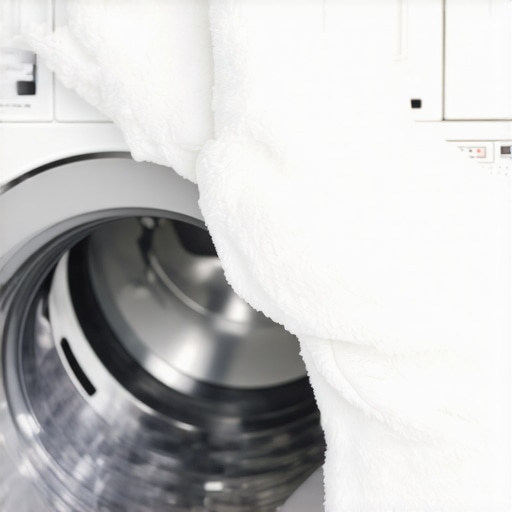
I still remember the smell of scorched rubber and the rhythmic, terrifying thwack-thwack-thwack that echoed through my laundry room three years ago. I thought I was being productive by forcing my massive, king-sized winter comforter into my old top-load machine. I ignored the groan of the motor and the fact that the lid barely closed. Ten minutes later, my machine literally walked three inches to the left and died. It was a $400 mistake that I don’t want you to repeat. Washing these heavy beasts isn’t just about getting them clean; it’s about protecting the heart of your home. If you’ve ever wondered why your top load washer is making a loud banging noise, you’ve likely felt that same heart-sinking panic I did. Today, I’m going to share the exact method I use now—one that keeps my bedding fresh and my motor spinning happily for years to come. [image_placeholder]
Your Washer Capacity is a Hard Limit Not a Suggestion
Most of us assume that if we can physically shove the fabric inside and latch the door, we are good to go. But comforters are deceptive. They are light and airy when dry, but once they soak up gallons of water, they transform into heavy, sodden anchors that can snap a drive belt or knock a drum completely off its suspension. I learned the hard way that choosing the best settings for washing your heaviest winter bedding is about much more than just clicking the ‘Heavy Duty’ button and walking away. It’s really about weight distribution and physics. According to the experts at the Association of Home Appliance Manufacturers, exceeding the recommended load capacity even once can cause permanent misalignment of the wash tub. You might think you’re saving a few bucks by avoiding the commercial machines at the laundromat, but you might actually be fast-tracking a thousand-dollar trip to the appliance store. Trust me, I’ve lived through the regret.
Can a standard home machine really handle a King comforter?
It’s the question I get asked most often when neighbors see me hauling my bedding out to the garage. The answer is a cautious yes, but only if you know the limits of your specific gear and how to work with the technology. If you have a modern High Efficiency (HE) machine, you might have noticed why your high efficiency washer doesn’t fill all the way to the top, which often leads people to panic and add extra water manually. Please, don’t do that! It completely messes with the machine’s ability to balance the load. My biggest mistake early on was ignoring the specific ‘Bedding’ cycle sensors. I ended up having to learn how to reset the error codes on your modern smart washer more times than I care to admit after the machine simply gave up mid-spin. Have you ever stood over your machine, hand on the lid, praying it doesn’t explode during the final spin cycle? Tell me I’m not the only one who has done the ‘laundry prayer’ in the comments below! We are going to fix that anxiety today by looking at how to prep your comforter so it behaves itself once the water starts pumping.
Master the Art of the Balanced Load
The secret to a successful wash isn’t just the machine; it’s the physics of how you arrange the fabric. I remember a freezing Tuesday in January when I tried to wash my duvet by simply shoving it in like I was stuffing a sleeping bag into a sack. Within minutes, the machine sounded like a helicopter was landing in my kitchen. When I opened the lid, the comforter had knotted itself into a massive, heavy ball on one side of the drum. I actually ended up having to learn how to level a washing machine on an old slanted floor because the sheer force of that unbalanced spin had shifted the entire unit. Now, I use the ‘jelly roll’ method. Lay your comforter flat on the floor, fold it in half or thirds, and then loosely roll it. Place it in the washer drum in a circle, like a giant donut. This leaves the center open, allowing the water and the agitator (or the drum’s fins) to move the fabric evenly.
Stop Drowning the Fabric in Soap
One of the most common mistakes is thinking a bigger load needs a mountain of soap. It’s actually the opposite. In a high-efficiency environment, excess suds act like a cushion between the fabrics, preventing them from rubbing together and getting clean. Even worse, those suds can get trapped in the thick batting of your comforter. I once pulled my ‘clean’ bedding out only to find it felt slimy; it took three extra rinse cycles to fix it. This is exactly why your washer doesn’t need a whole cup of detergent to get clothes clean. Stick to two tablespoons of a high-quality HE liquid. If you use too much, you might notice why your clothes come out of the washer with mysterious white streaks, which are essentially just dried soap deposits that will irritate your skin all night long.
Choose the Cycle That Actually Protects Your Gaskets
Don’t just default to ‘Heavy Duty.’ On many modern machines, the ‘Bedding’ cycle is specifically programmed to handle the unique weight of a comforter. It uses a different spin profile that ramps up slowly to prevent the drum from hitting the sides of the cabinet. If your machine doesn’t have a bedding setting, go with ‘Delicate’ or ‘Bulky.’ Because of how these machines operate, you might wonder why your high efficiency washer uses barely any water during this phase. It’s intentional. The machine is saturating the fabric slowly to maintain balance. Just be prepared for the clock; this is a marathon, not a sprint, which explains why your high efficiency washer takes so long to complete a load compared to the old-school machines our parents had.
How to Handle the Spin Cycle Panic
If you hear a rhythmic thumping, don’t ignore it. That is the sound of your machine’s suspension springs screaming for help. When this happened to me last year, I paused the cycle immediately. The comforter had shifted to one side during the drain. I manually redistributed the wet fabric, making sure it was evenly spread around the perimeter of the drum. If you let it go, you’ll eventually be searching for why your washing machine is moving across the floor during the spin. A quick 30-second manual adjustment can save you a $200 service call for a snapped suspension rod. It’s about being proactive rather than waiting for the error code to pop up.But the real expertise doesn’t stop at just balancing the load; it’s about understanding the silent killers that exist inside those sleek control panels. It’s a common misconception that the ‘Eco’ button is a one-size-fits-all solution for every load. In my experience, relying solely on low-temperature cycles is the fastest way to build up a ‘scrud’—that nasty mixture of detergent residue and body oils that coats your drum. While it’s true that your high efficiency washer uses barely any water, that limited volume needs heat to effectively break down organic matter. If you never run a hot cycle, you’re essentially inviting mold to colonize your outer drum. Experts at the American Cleaning Institute suggest that at least one hot wash cycle a month is necessary to properly sanitize the machine’s internal components and prevent biofilm.
The Fabric Softener Trap That Ruins Modern Motors
Here is a hard truth: your machine hates fabric softener even more than your towels do. It doesn’t just coat the fibers of your clothes; it coats the sensors, the heating element, and the drainage tubes. This is exactly why you should never use too much fabric softener in your smart washer. Over time, that waxy buildup creates a breeding ground for bacteria, which is the real reason your high efficiency washer smells like old gym socks. I’ve seen people replace perfectly good machines because they couldn’t get rid of the funk, not realizing they were the ones causing it with every ‘fresh scent’ capful.
Will a smart appliance actually save your wallet or just your time?
Many of my readers ask if the extra investment for a Wi-Fi-enabled model is just for the novelty. The hidden nuance is that these smart features are diagnostic tools first and convenience tools second. For example, knowing the 5 mistakes that are shortening the life of your smart refrigerator can be automated via push notifications. A smart fridge can alert you to a failing compressor or a dirty condenser coil before you lose hundreds of dollars in groceries, making you wonder is a smart fridge really worth the extra money. The answer is usually yes, but only if you actually engage with the telemetry data it provides. However, be careful with the ‘Quick Wash’ obsession. We often get frustrated by why your energy efficient washer takes so long to finish, but cutting that time down manually often leaves residual moisture in the system, which can lead to premature corrosion. Have you ever fallen into this trap of over-using the ‘quick’ or ‘eco’ settings and noticed a change in performance? Let me know in the comments. I’m curious if you’ve noticed that ‘old machine’ smell creeping into your laundry room!
I once spent three hours on a Saturday afternoon trying to figure out why my dishwasher smelled like a swamp even after running three cleaning cycles. I had checked the door seal and used every store-bought cleaner imaginable. It wasn’t until I reached into the very back and twisted a plastic assembly I’d never noticed before that I found the culprit: a rotting piece of bell pepper and a layer of grey slime. This is why you need to know the best way to clean a smelly dishwasher without using bleach before the odor takes over your entire kitchen. We treat these machines like magic boxes that make dirt disappear, but that dirt has to go somewhere, and usually, it’s sitting in a filter waiting for you to intervene. If you’ve noticed why your dishwasher still has standing water in the filter area, your machine isn’t broken; it’s just gagging on the debris we’ve forced it to swallow.
Stop Ignoring the Slimy Filter at the Bottom
Your washing machine has a similar ‘secret’ trap. If you have a front-loader, there is likely a small door on the bottom right. Inside is a drain pump filter that catches coins, hair ties, and enough lint to knit a sweater. I make it a habit to drain this once a month. If you don’t, you’ll eventually be forced to learn how to clean the lint filter you didn’t know your washer had while water is actively leaking onto your floor. It’s a messy job, but it is the difference between a machine that lasts five years and one that lasts fifteen. This isn’t just my opinion; according to Samsung’s technical white paper on Inverter Linear Compressors, the strain of pushing water through a partially blocked system is one of the leading causes of premature motor failure. By keeping these paths clear, you are literally buying yourself years of extra performance and ensuring the secret to making your refrigerator last twice as long applies to your laundry room too.
Your Vacuum is the Best Refrigerator Tool You Own
Speaking of refrigerators, most of us forget that they are essentially giant heat exchangers. If the coils are covered in pet hair and dust, the compressor has to work twice as hard. I use a simple $10 flexible vacuum attachment to reach under the grille. It is a 5-minute task that prevents 5 mistakes that are shortening the life of your smart refrigerator. When those coils are clean, your fridge doesn’t just run quieter; it stops the cycle of why your new refrigerator is making a loud humming sound every time it tries to drop the temperature by a single degree.
How do I maintain these high-tech systems without an engineering degree?
The beauty of modern tech is that you don’t have to guess. Most people ignore the diagnostic apps, but I use mine to track cycle counts. When my app tells me it’s time for a ‘Tub Clean’ cycle, I don’t skip it. If the screen ever freezes or acts up, knowing how to hard reset your smart refrigerator control panel can save you from a panicked call to a technician who will charge $150 just to flip a software switch. I also suggest learning how to clean the hidden debris under your refrigerator grille once every spring. It’s about being the boss of your technology rather than a victim of its complexity.
AI Sensors Will Soon Predict Your Next Breakdown
Looking ahead, the future of home appliances: trends to watch in 2025 suggest that we won’t even have to remember these chores. We are moving toward predictive maintenance where AI sensors will detect a slight change in vibration or power draw and order the replacement part before the machine actually breaks. Until then, the responsibility sits with us. I challenge you to go into your kitchen right now and check your dishwasher filter. If it feels slimy, give it a scrub with some warm soapy water and an old toothbrush. You’ll be amazed at how much better your machine performs tonight. Don’t wait for an error code to start caring for the heart of your home.
Why the Quick Wash Button is Actually Your Worst Enemy
One of the most profound realizations I had was that speed is the enemy of thoroughness. While a 15-minute wash sounds like a dream, it often fails to reach the temperatures needed to kill bacteria, leading to that ‘old laundry’ smell. I’ve also found that keeping your appliance sensors clean is just as important as the laundry itself; a dirty sensor can make a smart machine act remarkably dumb. Lastly, always remember that ‘Eco’ modes are great for energy, but running a hot ‘Tub Clean’ cycle once a month is a non-negotiable insurance policy against biofilm buildup.
Resources to Bookmark Before Your Next Upgrade
I don’t make any purchase without consulting the technical white papers from the Association of Home Appliance Manufacturers—they provide the raw data that marketing brochures hide. For those of you looking to modernize your workflow, I highly recommend the ultimate guide to smart home appliances as a starting point. If you’re living in an area with high utility costs, finding washing machines that save water can pay for itself in less than two years. I also frequently check the latest future of home appliances: trends to watch in 2025 to see which features are worth the extra cash and which are just gimmicks.
Stop Reacting to Breakdowns and Start Preventing Them
Managing your home appliances shouldn’t feel like a part-time job, but a little bit of proactive care goes a long way. When you treat your machines with respect—balancing the loads, cleaning the filters, and using the right cycles—they will reward you with years of trouble-free service. It’s about creating a home environment that works for you, not against you. Understanding how smart washing machines can simplify laundry day is just the tip of the iceberg in building a truly efficient household. Have you ever discovered a ‘hidden’ filter or a maintenance tip that completely changed how you use your machine? Let me know in the comments below!