
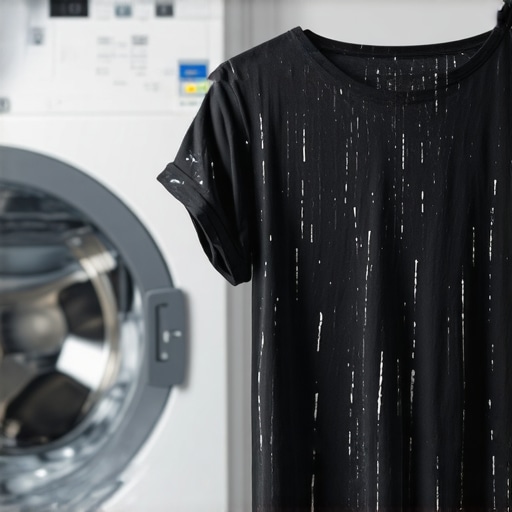
I remember the exact moment my heart sank; I was pulling my favorite pair of jet-black skinny jeans out of my brand-new high-efficiency washer, only to find them covered in what looked like ghostly white zebra stripes. I actually thought I had accidentally washed a tissue or, worse, that the machine was leaking bleach. It was a total gut-punch because I’d spent good money on that machine specifically to take *better* care of my clothes. If you have ever felt that same flash of rage while staring at a ruined load of laundry, believe me, you are not alone. These phantom streaks are the number one complaint I hear from neighbors and friends who have made the jump to modern appliances. Today, I am going to peel back the curtain on why this happens and show you exactly how to fix it without having to scrub your clothes by hand.
Stop blaming your detergent for those annoying white lines
It is so easy to assume you bought a bad batch of soap, but the reality is usually much more mechanical. The biggest mistake I made early on was treating my high-efficiency machine like my old-school top loader. I used to think more bubbles meant a deeper clean, but that is a recipe for disaster in a modern setup. Because why your high efficiency washer uses barely any water is actually by design, there simply isn’t enough liquid to flush away an avalanche of suds. When that excess detergent doesn’t dissolve, it clings to the fabric as it drains, leaving those chalky residues behind. I’ve found that even why your energy efficient washer leaves your clothes feeling crunchy often boils down to this same lack of a proper rinse. You have to remember that these machines are precision instruments, not blunt tools.
Is high-efficiency technology actually a scam?
I get it—it feels like we traded cleaning power for a fancy digital display and a higher price tag. You might be tempted to go back to the old ways, but the truth is that HE machines can clean better if you play by their rules. According to the American Cleaning Institute, high-efficiency detergents are formulated to be low-sudsing specifically because excessive foam can actually cushion the clothes, preventing the physical agitation needed to knock dirt loose. If you are seeing streaks, it is a sign that the chemistry in your drum is out of balance. I had to learn the secret to using less detergent in your high-efficiency washer the hard way after ruining three work shirts in one week. Once I scaled back and focused on how I was loading the machine, those white marks vanished almost overnight. Have you ever pulled a ‘clean’ shirt out only to find it looks worse than when it went in? We’re going to stop that cycle right now.
Measure your detergent like a scientist not a chef
If you are still pouring detergent until it looks ‘about right,’ you are effectively sabotaging your laundry. I used to treat my detergent cap like a suggestion, filling it to the brim because I thought my gym clothes needed the extra boost. The result? A sticky, greyish sludge that never fully rinsed out. Think of detergent like salt in a soup; a little enhances everything, but too much makes the whole thing inedible. In a high-efficiency machine, you rarely need more than two tablespoons of liquid. In fact, learning the truth about high efficiency detergent in old washers taught me that these formulas are incredibly concentrated. When you over-pour, the machine’s sensors get confused by the ‘oversuds,’ and it might even cut the cycle short to protect the motor, leaving that white residue locked in the folds of your clothes.
Give your clothes room to breathe
Modern drums are huge, which is a double-edged sword. It is tempting to shove every last towel into a single load, but these machines rely on ‘tumble action’ to move water through the fabric. If the clothes are packed in like sardines, the water—which is already limited—can’t reach the center of the pile. I learned this lesson the hard way when I tried to wash my daughter’s entire soccer team’s uniforms in one go; half of them came out bone dry in the middle and covered in soap marks. You should only ever fill the drum about three-quarters full, leaving enough space for the clothes to drop and splash. This is especially vital when you are washing machines that save water expert advice for 2025 suggests keeping loads balanced to ensure the spin cycle actually extracts the soapy water instead of just vibrating against it.
Check the settings you usually ignore
Most of us are guilty of pressing the ‘Normal’ button and walking away. However, if you are dealing with streaks on dark fabrics, the ‘Extra Rinse’ button is your best friend. I started using this for my black work trousers, and the difference was night and day. If you suffer from skin sensitivity, you might wonder does the extra rinse cycle actually help with detergent allergies, and the answer is a resounding yes because it physically flushes away those last stubborn surfactants. Additionally, don’t be afraid of heat. While we want to save energy, some detergents simply won’t dissolve in ice-cold water. If you have heavy stains, knowing how to use the steam setting on your washer for better stain removal can help break down both the dirt and the detergent more effectively than a standard cold wash.
Clear the path for the water to escape
If your clothes are coming out with streaks, the water might not be draining as fast as it should. Every few months, I take a deep breath and open that little door at the bottom of my front-loader to find the debris filter. One time, I found three quarters, a hair tie, and enough lint to knit a sweater. That blockage was slowing down the drainage, meaning the dirty, soapy water was just sitting in the bottom of the drum during the final spin. Learning how to clean the debris filter on your front load washer effectively is a dirty job, but it’s the only way to ensure your machine isn’t just recycling its own filth. If you’ve noticed a drop in performance, this is almost always the culprit. Even when I was tackling the trick to washing bulky comforters without killing your machine, I realized that if the drain path isn’t clear, no amount of ‘smart’ technology can save your laundry from looking streaky.
If you think you’re being a hero by running every single load on the ‘Eco-Cold’ setting, I have some bad news for you. While it’s great for your utility bill, it is often a death sentence for the internal hygiene of your machine. In my years of troubleshooting, I’ve seen what happens when the water never gets hot enough to melt away body oils and fats. This leads to what industry insiders call ‘scrud’—a waxy, grey sludge that coats the outer drum where you can’t see it. This is exactly why your washing machine is leaving black spots on clothes even when it’s supposedly cleaning them. A study by the Association of Home Appliance Manufacturers (AHAM) highlights that detergents with certain enzymes require specific temperature thresholds to truly break down organic matter; without that heat, the residue just accumulates. Once that biofilm takes hold, your ‘clean’ clothes are essentially being bathed in a soup of old bacteria and stagnant oils.
Why does your washer suddenly add twenty minutes to the clock?
Have you ever stood there, bag packed and ready to leave, only to see the ‘1 minute remaining’ sign stay on for a literal eternity? You aren’t crazy. Your machine is likely equipped with a turbidity sensor that ‘sees’ how dirty the rinse water is. If you used too much soap or the clothes are still shedding grime, the AI brain forces an extra rinse or spin. This is the primary reason why your energy efficient washer takes so long to finish compared to your old mechanical unit. It’s not a glitch; it’s the machine trying to save you from the consequences of over-sudsing. #IMAGE_PLACE_HOLDER_C#
The natural cleaning hack that actually ruins your machine
I see this advice everywhere: ‘Ditch the fabric softener and use white vinegar.’ It sounds like a win-win for the environment and your wallet. However, as an appliance enthusiast, I have to warn you: vinegar is an acetic acid. While it’s great for descaling a kettle, constant exposure can significantly degrade the ethylene-propylene diene monomer (EPDM) rubber used in many front-loader door seals and internal hoses. Over time, that ‘natural’ hack can lead to a very expensive puddle on your laundry room floor. If you’ve already noticed a musk, finding the only way to get that weird smell out of your front loader usually involves a dedicated high-temp cleaning cycle with a proper oxygen-based cleaner, not just a splash of salad dressing. You need to treat the cause, not just mask the scent.
Think twice before jumping into the smart home hype
We all want a ultimate guide to smart home appliances for a modern living experience, but don’t let the Wi-Fi logo be your only guide. The ‘Oops’ factor here is ignoring the physical build quality in favor of a fancy app. A smart washer with a flimsy suspension system will still vibrate your house apart, regardless of whether it can send a notification to your watch. Have you ever fallen into the trap of buying an appliance for a ‘cool’ feature you never actually used? Let me know in the comments. Whether you are looking for washing machines that save water expert advice for 2025 or just trying to survive your weekly mountain of towels, the nuance is always in the maintenance and the chemistry, not just the purchase price.
Trust your tools more than your machine’s display
I have a confession: I don’t believe the numbers on my refrigerator screen. After years of testing, I’ve realized that internal sensors can drift by as much as five degrees over time. That is why the most important tool in my kitchen isn’t a smart gadget, but a simple $15 digital probe thermometer. I use it to verify that my milk is actually at 37°F and my freezer is at a crisp 0°F. If you want the secret to making your refrigerator last twice as long, you have to verify the environment manually. I’ve seen fridges struggle for months because a blocked vent caused a ‘false’ reading on the display, leading to a burnt-out compressor. Taking five minutes to learn how to calibrate your smart fridge temperature sensors will save you hundreds in spoiled groceries and repair bills.
How do I keep my appliances running like new for a decade?
Consistency beats intensity every single time. You don’t need a deep-clean every weekend; you need a strategic rhythm. Every three months, I run a descaling agent through my dishwasher. I prefer oxygen-based powders over liquid gels because they break down the calcium carbonate that clogs up the spray arms. It’s about maintaining the ‘flow’ of the machine. If you are looking for the best way to sanitize your dishwasher without using bleach, focus on heat and citric acid-based cleaners. These keep the internal seals supple without the corrosive effects of chlorine. I also apply this same logic to my oven; if the bake feels uneven, I don’t call a technician right away. Instead, I follow the steps for how to recalibrate your smart oven when the temperature feels wrong to see if the software just needs a nudge back to reality.

Beyond manual tools, your smartphone is actually a powerful diagnostic instrument. Many modern units from brands like LG or Samsung have an acoustic ‘Smart Diagnosis’ feature. You hold your phone up to the power button, and it ‘sings’ a sequence of tones that tells the app exactly what is failing inside. According to technical documentation from Yale Appliance, utilizing these built-in diagnostic tools can resolve nearly 30% of ‘malfunctions’ without a physical service visit. It turns a mystery into a simple part-swap you can do yourself. I predict that the future of home appliances trends to watch in 2025 will shift toward ‘self-healing’ systems where the machine automatically adjusts its cycle parameters to compensate for worn parts before you even notice a problem.
Expect your appliances to start talking back soon
We are moving toward an era of ‘Predictive Maintenance.’ Soon, your washer won’t just tell you it’s finished; it will send an alert saying the drain pump is drawing 10% more power than usual, suggesting a clog is forming. This is the ultimate peak of ultimate guide to smart home appliances for a modern living. But until that AI future is fully here, you are the brain of the operation. My challenge for you today? Go find your refrigerator’s condenser coils—usually behind a bottom grate—and vacuum them. It sounds boring, but a dust-free coil can drop your energy usage by 15% instantly. If you’ve been putting off basic maintenance, now is the time to start. Try that one coil-cleaning tip this weekend and see if your fridge stops that constant, annoying hum.
My Most Expensive Lessons in Modern Machine Logic
I once thought that hitting the ‘Heavy Duty’ cycle was the answer to every dirty load, but I was wrong. I’ve learned that modern machines are more like computers than tubs of water. One of the hardest truths to swallow is that the hidden costs of cheap budget appliances often show up in how easily their sensors get tripped by minor mistakes. I also realized that you don’t always need a pro when things go wrong; knowing how to fix a washing machine that stops mid-cycle without an error code has saved me from at least three unnecessary service calls over the last year. The machine isn’t failing you; it’s usually just waiting for you to help it breathe.
The Survival Kit I Use to Keep My Appliances Running
Maintenance shouldn’t feel like a chore if you have the right tools on hand. My ‘appliance first-aid kit’ includes a simple digital thermometer for the fridge, oxygen-based descaling tabs for the washer, and a smartphone with my manufacturer’s diagnostic app installed. If you are currently shopping for a replacement, looking into the most reliable washing machines for large families with heavy loads is a great starting point because these models are often built to withstand the specific pressures of modern detergent chemistry and high-speed drainage needs. I also keep a printed copy of my manual’s ‘Error Code’ page taped to the back of the laundry door—it’s a low-tech solution for a high-tech world.
You Are the Real Brain Behind the Smart Home
At the end of the day, moving toward an ultimate guide to smart home appliances for a modern living experience isn’t about letting the machine do everything. It’s about building a partnership where you provide the right chemistry and the machine provides the efficiency. As we look at the future of home appliances trends to watch in 2025, it is clear that machines will get smarter, but the basics of heat, space, and proper drainage will never change. Don’t be afraid to override the settings or push that extra rinse button—you know your laundry better than an algorithm does. Have you ever found a ‘surprise’ object in your debris filter that was secretly ruining your wash cycles? Let me know in the comments below!