
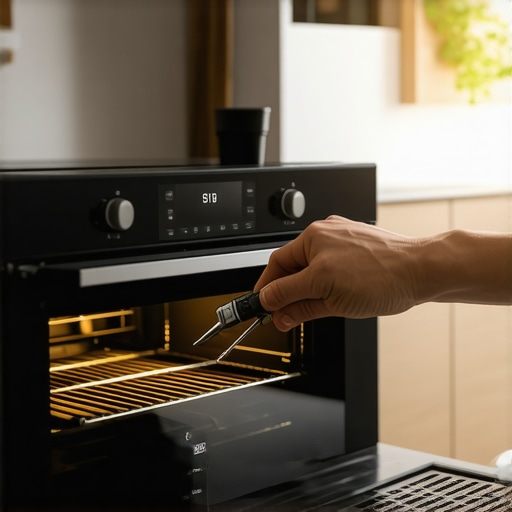
I was standing in my kitchen last Tuesday, staring at a tray of pale, sad-looking lasagna that should have been bubbling and golden. My phone had chirped a cheery notification ten minutes earlier saying my oven was preheated to 425°F, but when I opened the door, it felt like a lukewarm summer breeze. There is nothing more infuriating than a smart appliance that lies to your face. We pay a premium for these high-tech features, yet there I was, ordering pizza while my expensive oven sat there underperforming. If your oven is stubbornly refusing to hit that target temperature, I have been in your shoes, and I have finally figured out how to win the battle.
Stop Trusting the Digital Readout on Your Oven Screen
The first thing I learned the hard way is that the number on your display is often just a polite suggestion. Early in my journey with smart appliances, I made the mistake of assuming the digital sensor was infallible. I spent weeks blaming my recipes for being undercooked before I realized the oven was actually running thirty degrees cold. If you feel like your dinner is always running late, you might want to check why your smart oven takes significantly longer to preheat than usual. It turns out that according to the experts at Consumer Reports, nearly all residential ovens vary by at least 15 to 25 degrees, but smart sensors can get tripped up by steam, grease, or even a slight glitch in the firmware.
Is This Smart Technology Actually Worth the Headache?
It is a fair question. When you are hungry and the app is crashing, you start to miss the old-fashioned dials of the 90s. However, the problem usually isn’t the ‘smart’ part of the oven; it is the physical components that haven’t changed in fifty years. Heating elements still wear out, and door seals still leak. Before you give up and go back to a manual range, you should try to recalibrate your smart oven when the temperature feels wrong. Usually, a few tweaks in the settings menu can bridge the gap between what the sensor thinks is happening and the actual heat inside the cavity. Have you ever felt like your oven was gaslighting you about how hot it actually was? Drop a comment and tell me the most disastrous meal you’ve had because of a temperature glitch. Today, I am going to show you exactly how to diagnose whether you have a software bug or a hardware failure so you can get back to perfectly roasted chicken.
Getting your kitchen tech back on track is a lot like learning how to connect your smart oven to your home network without the frustration; it requires a little bit of patience and knowing exactly which buttons to push.
Force Your Oven to Speak the Truth with Recalibration
Most people do not realize their smart oven has a hidden offset feature. It is essentially a digital slider that tells the computer, “Hey, when you think it is 350, it is actually 325, so kick it up a notch.” You can usually find this under Settings or Service in your app. I remember the first time I found this; I was so frustrated by my lukewarm lasagna that I over-corrected the offset by 50 degrees. The next morning, my biscuits looked like charcoal briquettes. Precision matters here—adjust in five-degree increments until you hit the sweet spot. If your display is lying, learning how to recalibrate a smart oven thermostat that burns everything is the single most effective way to reclaim your kitchen’s reliability.
Dig Into the Secret Settings Menu
Accessing these settings is not always intuitive. Sometimes it requires holding down two buttons simultaneously for five seconds—like a cheat code in a video game. Once you are in, look for ‘Temp Offset’ or ‘Calibration.’ Think of this like adjusting the alignment on your car; the engine is running fine, but the direction is off. This is a core part of the ultimate guide to smart home appliances for a modern living, where the software gives you the power to override the factory defaults. If the software looks fine but the heat is still inconsistent, we have to move from the screen to the actual metal.
Examine the Hardware That Software Can Not Fix
Software cannot fix a physical hole in your oven’s defense. A heating element is a lot like a lightbulb; it does not just get tired, it eventually burns out or develops dead spots. If you see a spot on the element that is glowing brighter than the rest, or not glowing at all, it is failing. You can diagnose this similarly to how to tell if your dishwasher heating element is actually broken. If the element is visibly pitted or flaking, no amount of app updates will bring your temperature back to 400 degrees.
The Paper Test for a Leaky Gasket
Another common culprit is the door seal, or gasket. If this rubberized strip is cracked or compressed, your expensive heat is leaking into your kitchen. I once spent an hour scrubbing my gasket with a toothbrush, thinking grease was the problem, only to realize the internal magnets had failed. You should how to check if your refrigerator door seal is actually airtight using the same paper test: close the door on a single sheet of paper. If you can pull the paper out with no resistance, your oven is essentially trying to heat the entire house, and your thermostat will never reach its goal. A leaky seal forces the oven to work twice as hard, leading to those annoying preheat delays we discussed earlier.
Verify the Reality with an Analog Tool
Finally, never trust a single source of truth. Buy a cheap, standalone stainless steel oven thermometer. Place it in the center of the middle rack and let the oven sit at a set temperature for at least 20 minutes after the beep. This is the only way to prove whether your smart sensors are actually the problem or if you have a larger voltage issue at the wall outlet. It is a simple step, but it is the difference between guessing and knowing.
Beyond the simple recalibration steps, there is a deeper nuance that most smart appliance owners completely miss: the firmware trap. We have been conditioned to treat our ovens and washers like old-school mechanical tools, but they are essentially computers that happen to generate heat or spin drums. I see people ignore update notifications for months, assuming they are just cosmetic changes to the app interface. In reality, why your smart appliance app keeps asking for a firmware update is often linked to thermal regulation algorithms that prevent the very temperature swings I was fighting with my lasagna. Have you ever fallen into the trap of hitting ‘Remind Me Later’ until your appliance started acting erratic? Let me know in the comments.
Why Your Eco-Mode Might Be Slowly Killing Your Machines
Everyone tells you to use the energy-saving settings to lower your bills. In fact, most of us feel a little bit of ‘green guilt’ if we don’t. However, here is a contrarian take based on my years of troubleshooting: exclusively using ‘Eco’ or ‘Normal’ cycles on modern high-efficiency machines can actually lead to a premature death for the appliance. These cycles use lower water temperatures and less agitation, which sounds great for your bill but is terrible for grease and detergent breakdown. A recent study by the Association of Home Appliance Manufacturers (AHAM) indicates that low-temperature cycles are significantly more prone to developing biofilm and internal clogs. If you are not running a ‘Heavy Duty’ or ‘Sanitize’ cycle at least once a week, you are essentially letting gunk solidify in the pipes. This is exactly why your washing machine smells like damp towels even after a wash despite your best efforts to keep it clean.
Will Using White Vinegar Actually Rot Your Door Seals?
This is the question I get asked by every advanced user who wants to avoid harsh chemicals. The ‘life hack’ community loves vinegar, but the engineering truth is more complex. While vinegar is a great descaler, its high acidity can degrade the ethylene propylene diene monomer (EPDM) rubber used in many modern smart washer and dishwasher seals. If you overdo it, you will eventually be looking at how to replace the door seal on a front load washing machine because yours has become brittle and cracked. If you must use it, dilute it heavily and never let it sit on the gasket. Instead of relying on vinegar, focus on the basics like the secret to using less detergent in your high efficiency washer to prevent the buildup in the first place.
The Fatal Mistake of Detergent Overdosing
The biggest ‘oops’ factor in the modern kitchen isn’t a software glitch; it is the human tendency to think more soap equals more clean. Modern sensors in smart dishwashers and washers measure water turbidity (cloudiness). When you use too much detergent, the sensors get ‘blinded’ by the suds, leading to truncated cycles that leave a film on everything. This is a primary reason why your dishwasher is leaving a gritty white film on your plates. We have to unlearn the habits of the 90s. In the age of AI-driven appliances, less is almost always more. If you want a truly top smart appliances for a seamless home experience in 2025, you have to trust the machine’s ability to work with minimal chemistry. By understanding these technical nuances, you move from being a frustrated user to a master of your home ecosystem.
I have spent a small fortune on gadgets over the years, but the most important tool in my maintenance arsenal is a simple $20 infrared thermometer gun. When your fridge starts acting up, you cannot just rely on the internal thermometer—half the time, the sensor is blocked by a stray carton of milk or a bag of spinach. I use the infrared gun to map out cold spots and verify if the compressor is actually cycling correctly. This level of precision is what separates a truly ‘smart’ home from one that is just expensive and broken. According to technical bulletins from the Appliance Standards Awareness Project (ASAP), even a slight deviance in temperature consistency can increase energy consumption by up to 15% before a failure code is ever triggered by the machine itself. This is exactly why knowing how to recalibrate your refrigerators internal thermometer for better cooling is a skill you need to master today.
How do I maintain these high-tech machines over time?
Maintenance in 2025 is no longer just about a damp rag and some surface cleaner; it is about a digital and physical hygiene routine. Every three months, I perform what I call the ‘Deep Cycle Audit.’ I start with physical hardware by learning how to clean the debris filter on your front load washer effectively. A clogged filter forces the drain pump to work under higher voltage, which eventually fries the expensive control board. Then, I move to the dishwasher and check how to clean the internal spray arms of your dishwasher for better flow to ensure the AI sensors are not overcompensating for poor water pressure. If you are not doing this, you are essentially waiting for a $400 repair bill that could have been avoided with ten minutes of work.
Don’t Let Your Network Become the Weak Link
We often forget that these machines are nodes on a network, just like your laptop or phone. I have seen people lose their minds over a ‘broken’ dishwasher when the real culprit was a mesh router update that kicked the appliance off the 2.4GHz band. If you are serious about scaling your home tech and avoiding lag, you need to learn how to set up a central kitchen hub for all your smart appliances. This allows you to isolate these devices from your main streaming traffic, preventing the signal interference that causes those annoying notification delays or app crashes during a wash cycle. It is about building a robust infrastructure so your ultimate guide to smart home appliances for a modern living actually remains functional year-round.
Expect Your Fridge to Call the Repairman First
Looking ahead, I predict we are moving toward a ‘digital twin’ model for home maintenance. In the next few years, manufacturers will use edge computing to simulate wear and tear in real-time. Instead of you noticing a leak, the machine will detect a 2% drop in water pressure and automatically order a replacement gasket before you even see a puddle. We are already seeing the beginnings of this predictive AI in the top smart appliances for a seamless home experience in 2025. My challenge for you this weekend is to get ahead of the curve: Pull out your washing machine and check the leveling. If it is even slightly off, follow the steps on how to level a washing machine so it stops banging on tile floors to save your motor from a slow, rattling death. Your future self will thank you for the silence.
What the User Manual Never Tells You About Long-Term Care
After years of trial and error, I have realized that the real secret to longevity isn’t in the code; it is in how we respect the physical limits of our hardware. My biggest ‘lightbulb moment’ came when I stopped treating my washer like a magic box and started seeing it as a mechanical system that needs heat to stay clean.
- The Eco-Cycle Trap: Always use a high-heat cycle at least once a week to melt away fats and soaps that modern cold-water detergents simply cannot handle.
- Software vs. Hardware: If your temperature is off, check the seal before you blame the app. A $10 gasket is often the hero in a $1000 repair story.
- Data Matters: Keep an eye on how much bandwidth your kitchen consumes; sometimes a slow preheat is actually a weak Wi-Fi signal in disguise.
The Tools I Keep in My Kitchen Junk Drawer
I do not rely on fancy gadgets, but these four essentials have saved me thousands in unnecessary technician calls. First, a simple stainless steel oven thermometer is your best friend for verifying if your recalibration worked. I also swear by the Appliance Standards Awareness Project (ASAP) website for staying updated on energy efficiency changes. For my laundry room, I always keep a bottle of specialized cleaner because the truth about using white vinegar in your high efficiency dishwasher and washer is that it can do more harm than good to your seals. To ensure every cycle is effective, don’t forget to locate the hidden sensor in your dishwasher that needs a manual scrub. Finally, check out the latest refrigerators in 2025 top features that transform your kitchen to see how far sensor technology has come.
Your Kitchen Should Work for You
The transition to a high-tech home can feel overwhelming, but remember that these tools exist to simplify your life, not complicate it. By taking ten minutes each month to clean a filter or check a door seal, you are ensuring that your smart appliances remain the helpful assistants they were meant to be. We are living in an exciting era where the future of home appliances trends to watch in 2025 point toward machines that truly understand our needs. Do not be afraid to dive into those settings menus and reclaim control over your kitchen. Have you ever had a smart oven or fridge give you a completely different reading than an analog thermometer? I would love to hear your troubleshooting stories in the comments below!