
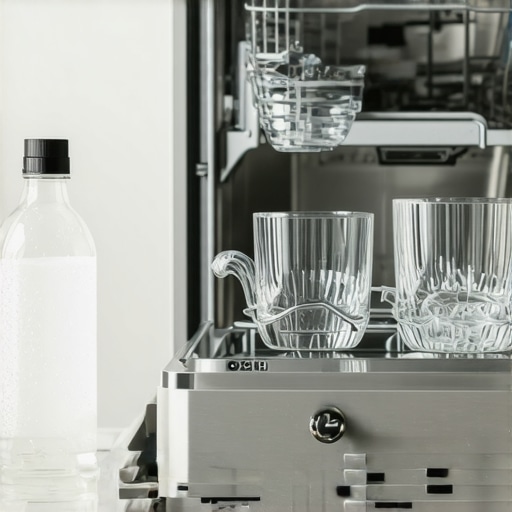
I pulled the top rack out and felt a familiar sink in my stomach. My favorite set of navy blue dinner plates—the ones I spent way too much on—were covered in a gritty white film. This wasn’t the sparkling clean the salesperson promised when I bought this high-efficiency machine. Like a lot of you, I jumped straight to the internet for a fix. “Use white vinegar,” the blogs screamed. “It’s cheap, it’s natural, and it works better than any store-bought rinse aid!” I followed that advice blindly for six months. I thought I was being the smart, eco-conscious homeowner. In reality, I was making a classic mistake that almost cost me a service call. Let’s talk about why your kitchen’s favorite multi-purpose liquid might actually be the villain in your appliance’s story.
Why everyone is suddenly obsessed with vinegar in the kitchen
It’s easy to see the appeal. We’re all trying to reduce the number of harsh chemicals in our homes, and vinegar feels like a miracle cure-all. In a world where innovative dishwashers with AI technology handle everything from soil sensing to auto-dosing, adding a splash of something from the pantry feels grounded and safe. But here is the catch: these high-efficiency (HE) machines are calibrated for specific chemical reactions. When I started pouring vinegar into my rinse aid dispenser, I wasn’t just “cleaning”—I was introducing a potent acid to a system designed for a base. I should have been focusing on the easiest way to clean the filter in your dishwasher instead of trying to chemically bypass the maintenance. Modern units are sensitive. They aren’t the tanks our parents had in the 90s.
Does this kitchen staple actually destroy your expensive machine?
This is where the skepticism usually kicks in. You might be thinking, “My grandmother used vinegar for forty years and her dishwasher lasted forever!” That’s a fair point, but your grandmother didn’t have a modern model with ultra-thin rubber seals and complex sensors. According to experts at Consumer Reports, the acetic acid in vinegar is strong enough to eat away at certain types of rubber hoses and gaskets over time. I learned this the hard way when I noticed the seal on my door started feeling gummy and less flexible. If you’re seeing a cloudy film on glasses, you might be tempted to use more vinegar, but you could actually be dealing with permanent glassware etching. I want to help you avoid the “gummy gasket” phase of homeownership. Today, I’m going to break down exactly when it’s okay to use vinegar and when you should keep that bottle far away from your appliance. Have you ever noticed your dishes getting worse after you tried an “all-natural” cleaning hack? We’re going to fix that. Often, the problem is just a hidden sensor in your dishwasher that needs a manual scrub, not a chemistry experiment.
Forget the Hacks and Clean the Spray Arms Instead
If you really want that sparkling finish, you have to get your hands a little dirty. Think of your dishwasher’s internal spray arms as the showerhead of the machine. If the holes are clogged with calcium or old food particles, no amount of vinegar is going to magically blast that off. I highly recommend learning how to clean the internal spray arms of your dishwasher for better flow once every few months. It’s a mechanical problem, not a chemical one. In my case, I once spent an entire afternoon wondering why my top rack was filthy, only to find a single popcorn kernel lodged in the center jet of the arm. It was blocking 80% of the water pressure. No ‘natural’ liquid was going to dissolve that kernel.
How to Tackle Hard Water Without Ruining the Gasket
If you live in an area with ‘liquid rock’ coming out of your pipes, you do need something to fight the scale. But instead of filling the rinse aid reservoir—which is the ‘heart’ of the machine’s drying system—just place a small, dishwasher-safe bowl filled with one cup of vinegar upright on the top rack. Run a cycle with no other dishes. This allows the vinegar to mix with the water at the right time without sitting in your lines and eating the rubber gaskets. It’s about controlled exposure. If you’re worried about germs, there is a better way to find the best way to sanitize your dishwasher without using bleach that doesn’t involve risking your warranty.
Check Your Sensors Before You Blame the Detergent
Modern innovative dishwashers with AI technology rely on ‘turbidity sensors’—basically the machine’s eyes—to see how dirty the water is. If these sensors are coated in a film, the machine thinks the dishes are clean when they aren’t. This is often why your dishwasher pod isnt dissolving completely; the machine cuts the cycle short because it’s ‘blind.’ 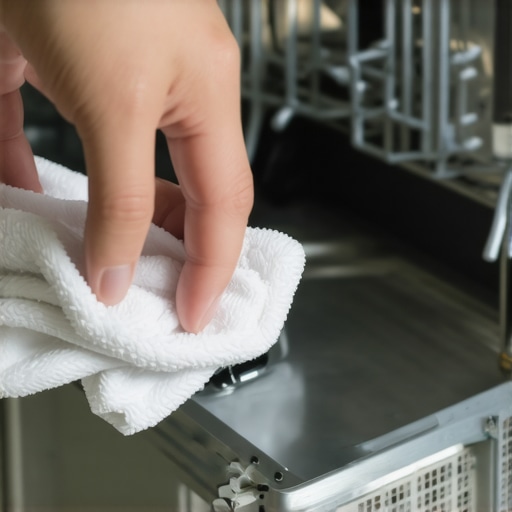 Use a soft cloth to wipe down the hidden sensor in your dishwasher located near the sump. I found that a simple wipe-down every month saved me more ‘gritty film’ headaches than a gallon of vinegar ever did.
Protect the Brain of Your Appliance
Your smart dishwasher has a control board that is essentially its brain. High-heat cycles combined with acidic vapors from excessive vinegar can actually lead to humidity getting into places it shouldn’t. If you’ve noticed why your smart dishwasher wont talk to your phone anymore, it might be a connectivity issue, but it could also be environmental stress on the internal components. Stick to the basics: the easiest way to clean the filter in your dishwasher is the foundation of all appliance health. Keep the acidity low and the manual maintenance high, and you’ll avoid that expensive service call.Let’s dig deeper into the ‘brain’ of these machines. Most people assume that ‘Smart’ means the appliance thinks for itself so you don’t have to. That’s the first trap. I often see homeowners treating their innovative dishwashers with AI technology like old-school mechanical beasts. The truth is, these machines are more like computers that happen to wash things than they are simple cleaning boxes. A common contrarian view I hold: stop using the ‘Heavy’ cycle just because you think it cleans better. According to studies by the Association of Home Appliance Manufacturers (AHAM), modern sensors are actually designed to work most efficiently on ‘Normal’ or ‘Eco’ settings; the heavy cycle often uses excessive heat that can actually bake proteins onto your plates, making them harder to clean in the long run. If you are still in the market for a new unit, understanding the smart appliances revolution: how to choose the best dishwasher is about looking for these sensor capabilities, not just the number of cycle buttons. The biggest ‘oops’ I see is the detergent overkill. If you’re using an HE washer, the secret to using less detergent in your high-efficiency washer is vital. Too many suds can actually confuse the sensors, leading to why your washing machine takes much longer than the timer says. The machine gets stuck in a ‘suds lock’ and adds more rinse cycles, wasting water and time. I’ve seen people lose hours of their day because they thought ‘more soap equals cleaner clothes.’
Why does your smart washer keep pausing without an error code?
It’s incredibly frustrating when you come back to the laundry room only to find the drum full of water. Before you call a technician, check if you’ve recently ignored a prompt on your phone. Many users don’t realize that why your smart appliance app keeps asking for a firmware update isn’t just about new features; it’s often about fixing bugs that cause mid-cycle hangs. If the software is out of sync, the hardware stalls. This is the ‘hidden’ maintenance of 2025. This same principle applies to your kitchen; you might notice why your refrigerator is freezing the eggs on the top shelf. It’s usually not a broken thermostat but a lack of airflow that the smart system is trying to compensate for. If you overstuff the top shelf, you block the vents, and the machine panics, blasting cold air that ruins your produce. Learning how to calibrate your smart fridge temperature sensors can save your groceries and your sanity. People often believe that the lower the temperature setting, the fresher the food, but the U.S. Department of Energy notes that keeping a fridge *too* cold actually forces the compressor to run in shorter, less efficient bursts, leading to premature wear. We also need to talk about the physical vs digital disconnect. You might be focused on the ultimate guide to smart home appliances for a modern living, but forget that even the smartest motherboard can’t overcome a hardware blockage. If you’re looking for the best smart refrigerators for busy meal preppers, remember that the tech is only as good as your willingness to maintain the physical components like coils and filters. Don’t let the shiny touchscreens distract you from the fact that these are still mechanical tools. Have you ever fallen into this trap? Let me know in the comments.It’s one thing to clean a filter; it’s another to troubleshoot why your $2,000 oven thinks 350 degrees is actually 325. If you’ve ever felt like your baking is ‘off,’ you should learn how to recalibrate your smart oven when the temperature feels wrong. I keep a cheap infrared thermometer in my kitchen drawer for this exact reason. It’s my ‘truth teller.’ When the digital display says one thing and my thermometer says another, I know it’s time to dig into the settings. This isn’t just about cookies; it’s about preventing the heating element from overworking and burning out. Modern control boards are also incredibly sensitive to ‘voltage sag.’ I actually installed a whole-home surge protector after a technician showed me how a minor brownout fried the logic board on his previous service call. According to research published by the Association of Home Appliance Manufacturers (AHAM), sensor drift is a leading cause of ‘ghost errors’ in high-efficiency units, often caused by micro-scale mineral buildup on thermal probes. This is why I always suggest you learn how to set up a central kitchen hub for all your smart appliances that includes professional-grade power conditioning. It sounds like overkill until you’re staring at a black screen on your fridge.
How do I maintain my home’s smart ecosystem over the long haul?
The answer is a mix of digital hygiene and old-school elbow grease. For the digital side, I treat my appliances like my laptop. I check for updates once a month to avoid the dreaded ‘firmware loop’ where a machine gets stuck trying to connect. For the physical side, I am religious about the vacuum. If you share your home with a golden retriever like I do, you need to know how to keep your refrigerator coils clean in a pet-friendly home. Pet hair is the silent killer of compressors. I use a flexible ‘coil brush’—a $10 tool that looks like a giant pipe cleaner—and it has probably saved me $5,000 in replacement costs over the last decade. If you really want the secret to making your refrigerator last twice as long, you have to keep the airflow clear. Similarly, don’t ignore physical vibrations. Learning how to level a washing machine so it stops banging on tile floors isn’t just about the noise; it’s about protecting the delicate solder joints on the internal Wi-Fi chip from being literally rattled apart.
Expect your appliances to predict their own deaths soon
Looking ahead, the future of home appliances: trends to watch in 2025 is moving toward ‘Predictive Maintenance’ driven by edge computing. We are moving past the era where you wait for a puddle on the floor. Soon, your dishwasher will sense a microscopic drop in water pump pressure and order its own replacement seal before you even see a drop of water. This is the ultimate goal of the ultimate guide to smart home appliances for a modern living. But until that AI is fully baked and in every home, you are the primary sensor. I want you to try this one advanced tip tonight: pull your washing machine away from the wall just three inches. If you see any fine black dust or ‘belt shavings’ on the floor, your motor is likely misaligned or the belt is beginning to fray. Finding that now, before the belt snaps mid-cycle, is the difference between a $50 DIY fix and a $600 emergency repair call. Don’t wait for the machine to tell you it’s broken—go look for yourself.
Why My Expensive Kitchen Tech Almost Failed Me
The biggest shift in my perspective happened when I realized that modern appliances are not self-healing. I used to think that ‘Smart’ meant the machine would compensate for my neglect, but it’s actually the opposite; high-tech sensors require even higher-quality maintenance. First, I learned that digital hygiene is non-negotiable. If you find yourself wondering why your smart appliance app keeps asking for a firmware update, remember that those bits and bytes are just as vital as the water pump. Second, physical stability is the foundation of longevity. I spent years ignoring a ‘walking’ washer, but learning how to level a washing machine so it stops banging on tile floors probably saved my internal control board from literal vibration damage. Lastly, I realized that the best tools aren’t chemicals, but simple physical inspections.
A Technician’s Toolkit You Can Build for Under Fifty Dollars
To keep your home running smoothly, you don’t need a degree in engineering—just a few specific items that I now swear by. A Flexible Coil Brush: This is the only way to effectively tackle the dust that chokes your fridge. I’ve seen how much better a unit runs when you know how to keep your refrigerator coils clean in a pet-friendly home. Infrared Thermometer: This is my go-to for verifying that ‘smart’ sensors are actually accurate. It’s essential for anyone who needs to recalibrate your smart oven. Microfiber Cloths: Never use abrasive sponges on sensors. A simple, damp microfiber is the best way to handle the hidden sensor in your dishwasher that needs a manual scrub. Whole-Home Surge Protection: Protecting the motherboard of your expensive appliances from voltage spikes is the ultimate insurance policy.
Own Your Machines Instead of Them Owning Your Weekend
The shift from reactive fixing to proactive care is what turns a stressful household into a seamless one. When you understand the ‘why’ behind the maintenance, you stop falling for vinegar hacks and start trusting the science of your smart appliances. It takes ten minutes a month to check a filter or a firmware update, but that small investment pays off in years of reliable service. You’ve invested in this technology to make your life easier—don’t let a little dust or a missed update take that convenience away. Have you ever accidentally ‘fixed’ an appliance only to realize you were using the wrong cleaning hack? Let me know below.